
As a kid, for a certain stretch of time, I got completely hooked on those gamebooks that were all the rage in the early 90s. You probably know the ones I mean – they gave you a choice to carry on one way or another, as predetermined by the Creator of the book. Depending on what we decided, we were sent off to the corresponding next section.
At first I was thrilled with them, because here I wasn't just an ordinary reader, here I was the Protagonist. In these books, I thought, we hold our hero's fate in our own hands. Here everything is down to us.
The more gamebooks I read, though, the more I realised that the options they offered me weren't the options I would have picked if I could. Let me illustrate with an actual scene from a gamebook: my hero is on a mission in the enemy's palace and has stumbled upon a Mysterious-Box. The options before me were, and I quote:
1. You feel the sides of the box and give it a shake before opening it. This choice carries the risk of slowing you down considerably. If you choose this option, turn to Section 123.
2. You carefully set the box aside and continue your expedition through the palace. This choice won't slow you down, but you risk missing information vital to your mission. If you choose this option, turn to Section 208.
The author hadn't included the option I would have chosen – you open the box without overthinking it. What idiot feels up the sides of a box and shakes it before seeing what's inside? – I thought indignantly – My grandma Pandora, that's who, always feeling up the sides of her boxes before opening them….
And so, little by little, I lost interest in gamebooks, because the choices they offered me weren't the choices I would have made. Whether my choices would have been the right ones is a whole other story.
Thirty-odd years later, I've come to the conclusion that real life is a lot like those gamebooks from the 90s. Supposedly we have some kind of free will and supposedly we can make some kind of free decisions. But usually they boil down to picking between 2-3 options, none of which really suits us.
Take, for example, the situation I found myself in right before running the Berlin Marathon 2025: because of an injury to my foot, I was unable to do even the minimum volume of training a marathon needs, including the two compulsory long runs of over 30 km.
My three longest training runs are 19, 23 and 25 km, and on top of them I add one Lion's Run of 20 km with a 10 km cool-down. Wildly insufficient, I know, since I already have a few marathons under my belt and I know what proper preparation looks like. In gamebook language, my options were laid out like this:
-
You skip Berlin. This is the safe option – you're guaranteed not to embarrass yourself. If you choose this option, put your feet up and watch the marathon on one of the streaming platforms.
-
You go to Berlin unprepared. This option carries the risk of a poor performance, a DNF, disappointment in yourself, disgrace in the eyes of the running community, and injury. If you choose this option, get on the plane to Berlin on 19.09.
For the few of my readers who aren't runners, let me explain that you don't skip Berlin lightly.
The Berlin Marathon is part of the chain of the 7 Majors. The other 42-kilometre courses in it are in London, New York, Boston, Chicago, Tokyo and (now also) Sydney. Running each of these courses earns you a virtual star on the Abbott Majors portal. And anyone who collects all 7 stars gets a special plaque made up of the 7 medals, plus everlasting glory in our merciless circles. It looks like this:
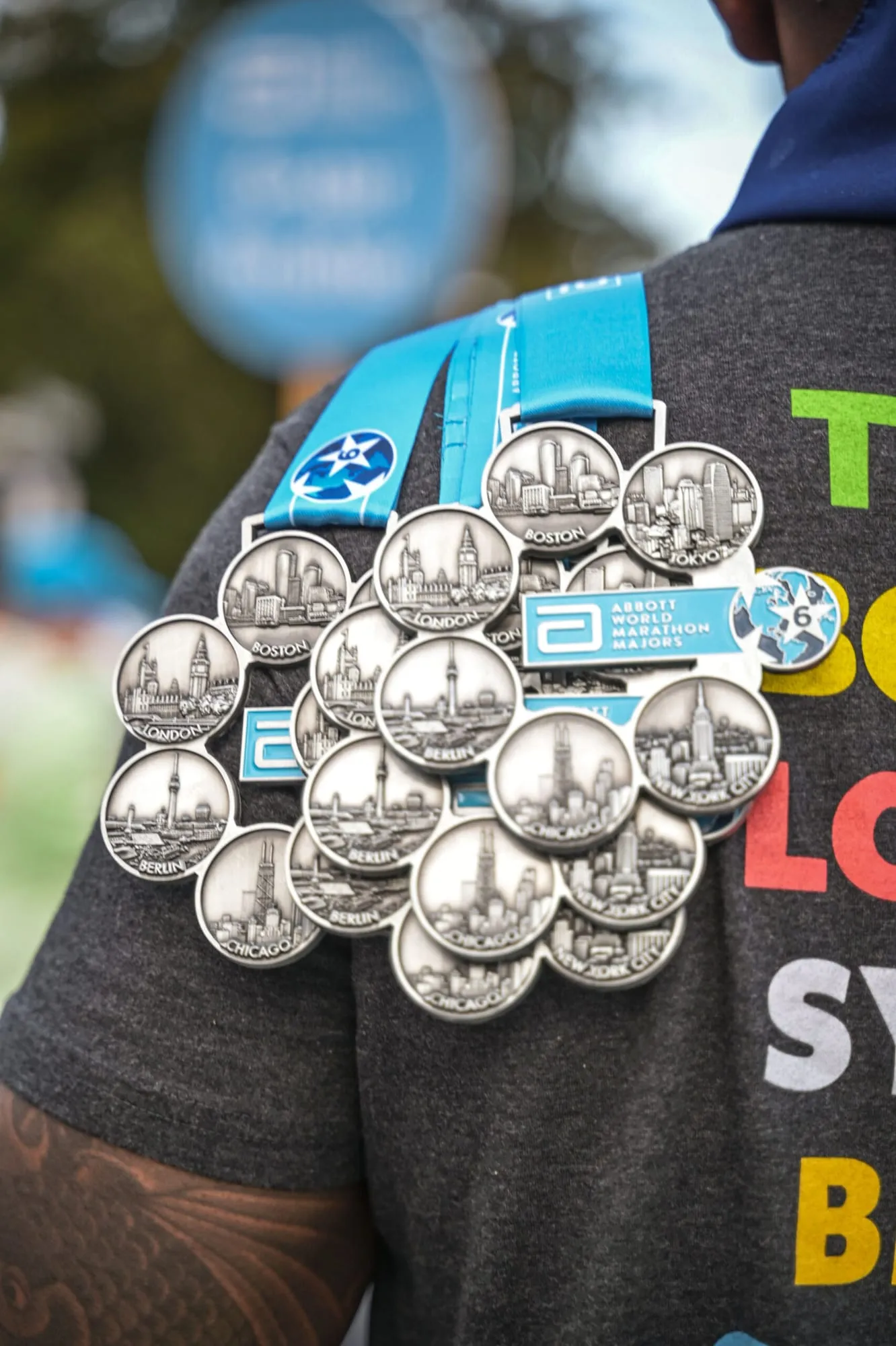
This clever little touch, which tickles the ego and the collector in every single one of us, makes these events so coveted that you can only get in through a ballot (the chance of being drawn is apparently around 5-6%), or (for some of them) by hitting a qualifying time.
In the light of all this, given that I already have one star from Sydney and I'm entered with a shot not only at a second star from Berlin but also at running a dream course that's super flat, option 1, “I skip Berlin”, is out of the question.
On 19.09 I travel with my whole family, and we go through all the mental states that are standard for us when travelling.
I, for instance, fall into a deep emotional crisis if we're not at the airport 2 hours before the flight. I know that 2 hours before any flight Emo is usually either washing his car or collecting some very important car gadget (say, a dashcam for recording and reporting road accidents) from the Econt courier office. So I suggest that I go on my own in good time, so as not to lose my mind, and he and the kids can come whenever they like and we'll just meet at the gate.
“Absolutely not!” Emo snaps. “What kind of family are we if we all make our way to the airport whenever we feel like it? This household needs some discipline. We travel together!”
“Travelling together” means travelling together on his schedule, and so here I am – two hours before the flight and I'm still at home, a total wreck. My nerves are red-hot and sizzling as I watch Emo calmly eating. And don't go thinking he's having a quick bite, gulping it down over the sink because we've got a plane to catch. No, no and no again.
My husband has settled himself at the table, warmed up last night's pasta carbonara and, being a man of fixed habits, has got out some hot peppers and chopped himself a nice little plate of nibbles. He's not giving his money to those airport robbers. A coffee there costs 4 euros!
An hour and 50 minutes before the flight, Emo has finished his lunch. I hiss the metro timetable at him through gritted teeth. I'm almost certain there are flecks of foam flying from my mouth.
“Stop it with your female hysterics – when I tell you we'll get there on time, we'll get there on time!” Emo is standing in front of the hallway mirror and, eyeing his reflection critically, smooths down an unruly lock of his black hair with a comb. He's 47 and hasn't got a single grey hair; and how could he – his nerves are like ship's ropes.
My next clear memory is of us at the gate, not only on time but early, before it's even opened. All right, let's say that this time Emo was right.
On the plane I run into Gavrail, who runs a marathon in about 3 hours. To give you a clearer picture of him, let me add that he's 62 and that he decided in 2025 to run one marathon every month. Why he decided to put himself through this ordeal I don't know – I asked him, and he isn't sure himself. I mainly associate his name with his achievements over the marathon distance, which he usually pulls off together with Desi, a girl my age from Smolyan, who, unlike me, went under 3:10 for the marathon a long time ago.
Lucky for me, Gavrail offers to pace me on Sunday. Well, of course I accept. We'll look for each other at the start on Sunday.
Clearly, living with Emo for so long has turned us into communicating vessels. The moment I caught the plane, all my worries drained out of me, and when we landed in Berlin they poured into Emo. Because in Berlin, my friends, the prices are such that we could only dream of that four-euro cappuccino at Sofia airport. And don't even get me started on the 15-euro sandwiches. These prices stress my husband out exactly as much as the thought of not being at the airport on time stresses me out.
The day before the marathon I collect my race number from the Expo without waiting a single second. German efficiency. I've always admired the Germans – an event for 80,000 participants run like clockwork. At the Expo Emo perks up, because we found a way to claw back the money so recklessly squandered earlier on coffee. Revolut had a stand where, if you showed your Revolut account on your phone, you got a free coffee or lemonade. Needless to say, all four of us queued up several times, until in the end I felt like throwing up from all the coffee, but at least we came out in the black. This deft financial manoeuvre of ours goes some way to restoring Emo's good mood.
I'll fast-forward through the rest of the day, as well as getting up at 6 the next morning and the most hassle-free use of public transport in a city with a closed-off centre and an event with 80,000 participants. Gavrail and I find each other and drop our clothes at the bag check (again, with no waiting whatsoever). The only place you could tell there were tens of thousands of us was the toilet queues, but at least 10% of us made use of the bushes in the park at the start, so that wasn't a problem either. Here we are, Gavrail and I, ready to plunge into the depths of the underworld known as the Berlin Marathon 2025.
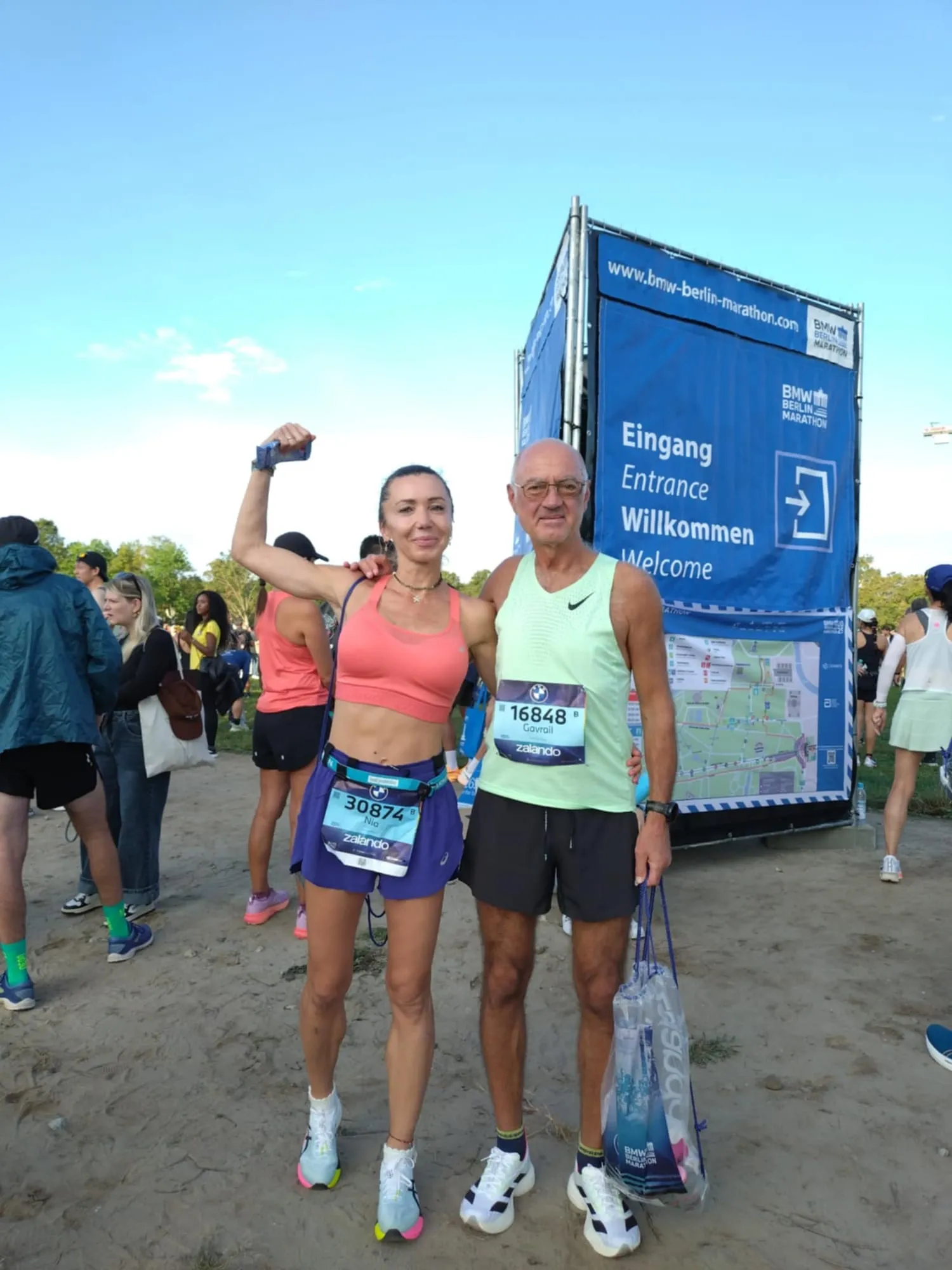
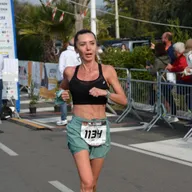
Every time I look at a photo of myself taken before a big ordeal, I think, oh boy, if only I'd known what was waiting for me just 3 hours later…. well, in this photo, even though this was my 5th marathon and not my 1st, I had no idea, absolutely no idea, how I was going to make every mistake in the textbook and how I was going to blow up, textbook-style.
But first things first. Gavrail and I set off at 4:25, which is my target pace for the whole slightly-over-42-kilometre distance. I know I ought to start slower, especially since I'm pretty underprepared, but I don't want to lose him as a pacer, so I stick with him.
I know how important it is to have someone to run with, and for that someone to be as experienced as Gavrail. I get worried watching good old Gavrail and me start ticking off the kilometres at under 4:20, because I know what I'm capable of and that pace is beyond me for 42 km. Yes, for the first 10 kilometres, on fresh legs and with the adrenaline pumping, you don't feel it, but I know that every second faster than target pace is a payday loan taken out from your body. And I also know that over the last kilometres I'll be paying back that payday loan, with the interest payday loans come with.
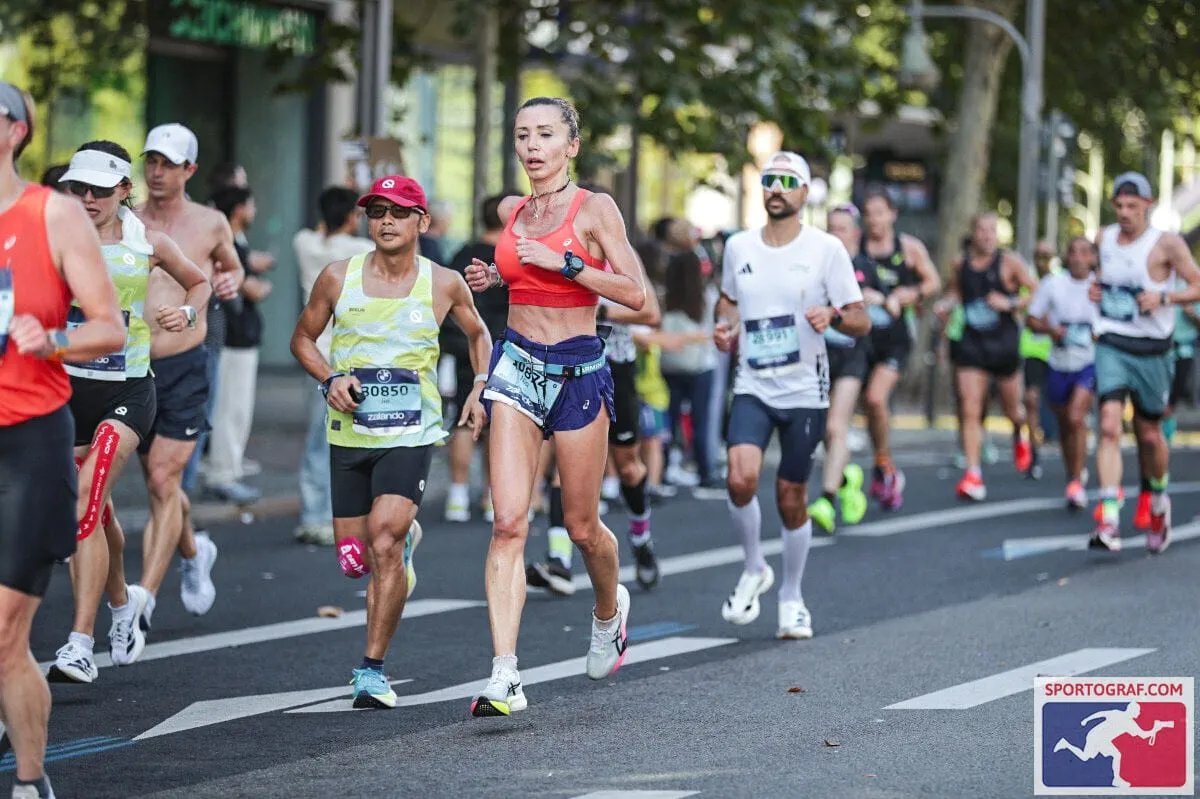
I distract myself from these dark thoughts by concentrating on not slowing down at every round 5 kilometres, when I take my gel and drink my water. Meanwhile the temperature has gone up quite a bit and the water stations are a mess. Not only is the column of runners piling up at the water stations three deep, but I literally had to plough a path through the cups thrown all over the ground. In honour of Sasho Nakov, I check whether besides water they're also offering Maurten's hydration mix. Yes, at every station – water, electrolytes, hydration mix, and at one station they were even handing out Maurten gels.
Somewhere around the 10th km Gavrail and I split up, and each of us carries on at our own pace. Before that, Hrisi Kozareva passes me – a woman who's run a marathon well under 3 hours – and we high-five and wish each other luck.
At the 12th kilometre, though, my legs start getting heavy, and the unpleasant feeling is made worse by a fact I already knew, but only truly took in once I saw it written down. A little man in the crowd was holding up a sign with the optimistic slogan “Only 30 kilometres to go”. My legs got even heavier just from the thought.
Time to start pulling mental tactics out of my pocket.
I started with the lightest artillery – breaking the “only 30 kilometres” I had left into chunks and concentrating only on holding the pace until the next chunk. Say – if I'm at the 12th kilometre, I think only about how to get to the 15th kilometre at this pace. There I'll distract myself with the mission “taking a gel”, followed by “drinking water from the station, breaking through a triple cordon of other water-drinkers without slowing down significantly”. That way, before you know it, I might reach the 16th kilometre without even noticing.
And so, with mental jokes and banter, I made it to the half-marathon sign, whose electronic display was showing 1:39 when I went past it. Just how scrambled my brain already was you can work out from the fact that it didn't occur to me that this was gun time, not my chip time (afterwards, in the official splits, I saw I'd gone through halfway in 1:33 and change).
_*_Gun time is the time from the start of the first competitor. Since at an event this big we start in waves, chip time is my time – it starts counting from the moment my turn comes to pass under the start arch, and accordingly it's the only time I should be looking at.
It was already tough. I'd already reached that moment, familiar to every one of us, when your stomach starts to turn, your legs are made of lead, unpleasant shivers run through your whole body, and the resistance your body feels is as if you're moving through clear jelly rather than air. If I've got 5-6 kilometres left, I'll pull myself together and somehow hold on. But when I've only just passed the middle of the course in a supposedly discouraging 1:39, and I've still got that much left…..
Right here, in the middle of the 22nd kilometre, the desire to just stop began wrapping its tentacles around my brain. Maybe if I'd thought to check my watch and seen I'd gone through halfway in 1:33, I'd have fallen apart less. At this stage I still depended on my mindset, not just on my physical state. With my whole body I began to crave the momentary relief my tensed-up muscles would get once I stopped running and they filled up with oxygen again.
How nice it would be to stop, to relax, to feel the sweetness of rest, to drink water calmly and breathe air calmly. For a few minutes I wrestle with the decision whether to stop or carry on. I think of all the people, my nearest and dearest and friends not quite so near, who are following my splits live in the marathon app.
If I'd been the hero of a gamebook about the Berlin Marathon, I'd have reached the section offering the following options (none of them to my taste, naturally):
-
You just stop. DNF. That way you get relief from your bodily torment. You'll disappoint all the people who wish you well, and above all you'll disappoint yourself. You'll be left without a Major medal. If you choose this option, stop running now, stop your watch and enjoy the temporary physical relief. Your disappointment in yourself will be eternal.
-
You carry on, but at an easy pace now, just to finish and get the medal. This option also brings physical relief, plus a medal on top. It seems like the most sensible one. The disappointment of not having given it everything will, again, be eternal. If you choose this option, drop your pace to 5:00 – 5:15 and carry on without pain.
-
You carry on at this pace for as long as you can. What will happen to you is anyone's guess. The torment ahead will be hellish, but you won't be disappointed in yourself. If you choose this option, swallow your pain, force yourself to eat a bit of gel and keep going through hell.
Of the three deeply unpleasant options, I go for number 3. The cliché that pain is temporary but disappointment is forever applies with special force to me. To my endlessly pleasant surprise, I manage to pull myself together and keep holding target pace. Every kilometre my watch chirps a pace between 4:20 and 4:25. Encouraged by this, I try to eat a bit of gel, because it's crystal clear to me that without calories I'm heading straight for the ugliest of blow-ups, but just the sight of the squeezed gel oozing out of the wrapper makes me want to bring up the contents of my stomach straight through my nose.
The pleasant surprise I'd given myself lasted until the 30th kilometre. We all know that's where the real running of the marathon distance begins. Up to there, if we're running the marathon properly, we should have been holding back. Now's when we have to start pushing. I pushed, going through yet another crisis and yet another urge to DNF. I'd already worn out the record about not wanting to disappoint my friends with my humiliation, and that motivation was starting to wear thin and give way to the inevitable physical processes that kept shutting down my body's functions one by one.
I'd been feeling sick for ages, and now I was starting to feel my arms and legs going numb. I was wondering how to motivate myself to push through the pain and the helplessness that were closing in on me ever more tightly from all sides.
And then the most powerful motivation of all struck my already scrambled brain like lightning: Emo! The poor boy drank so many expensive coffees and ate so many expensive sandwiches in the German capital, all just so I could swan around at yet another marathon. And by way of thanks I go and quit… No, no! I can't do that to him!…. In my head the motivation thundered in Emo's baritone: “Nia!!! Is this what I blew N euros in Berlin for??? So you could come home without a medal? Get a grip, woman!”
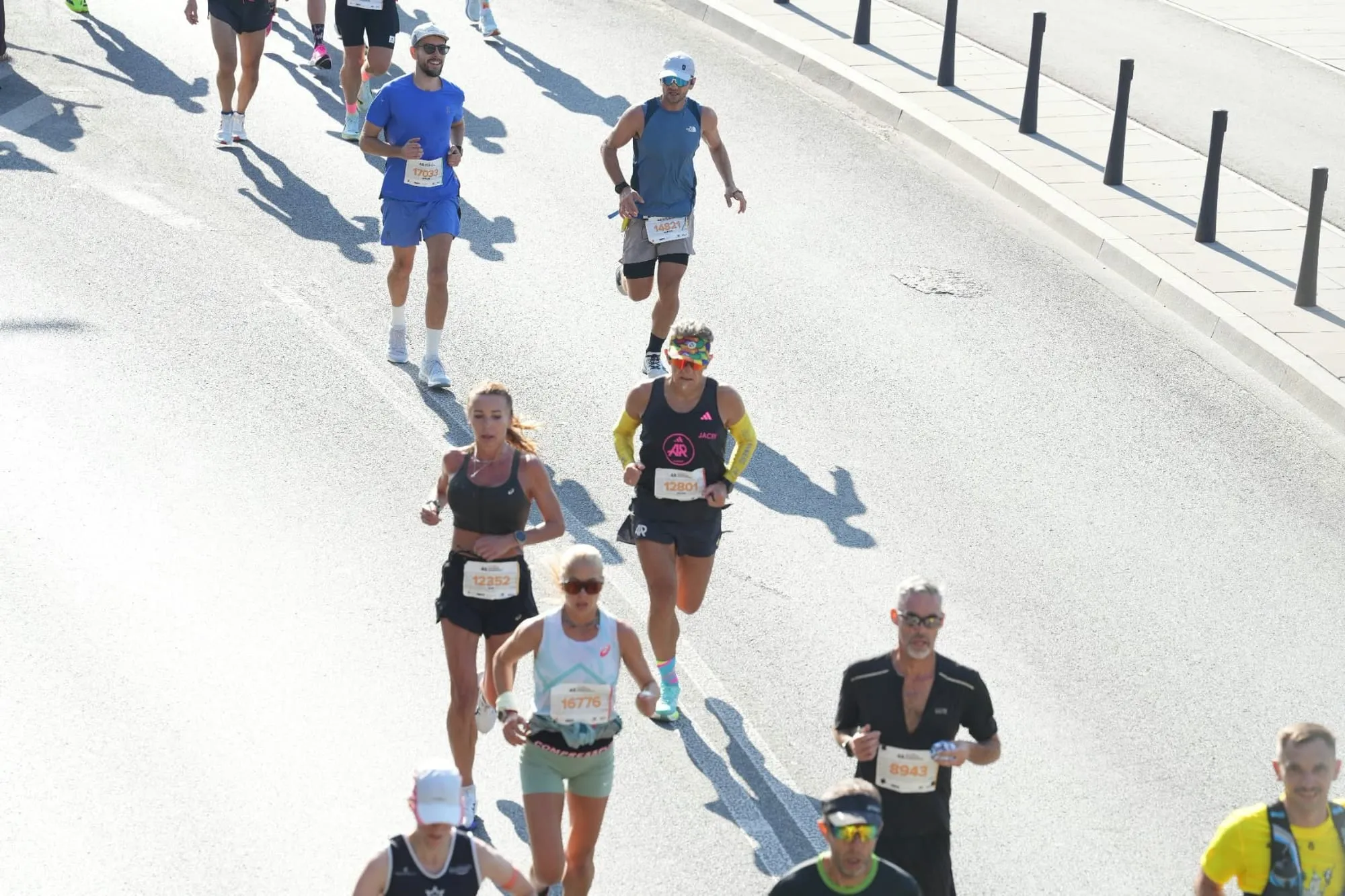
This photo is from that moment – I really love it, because from the outside I look like a person in complete control.
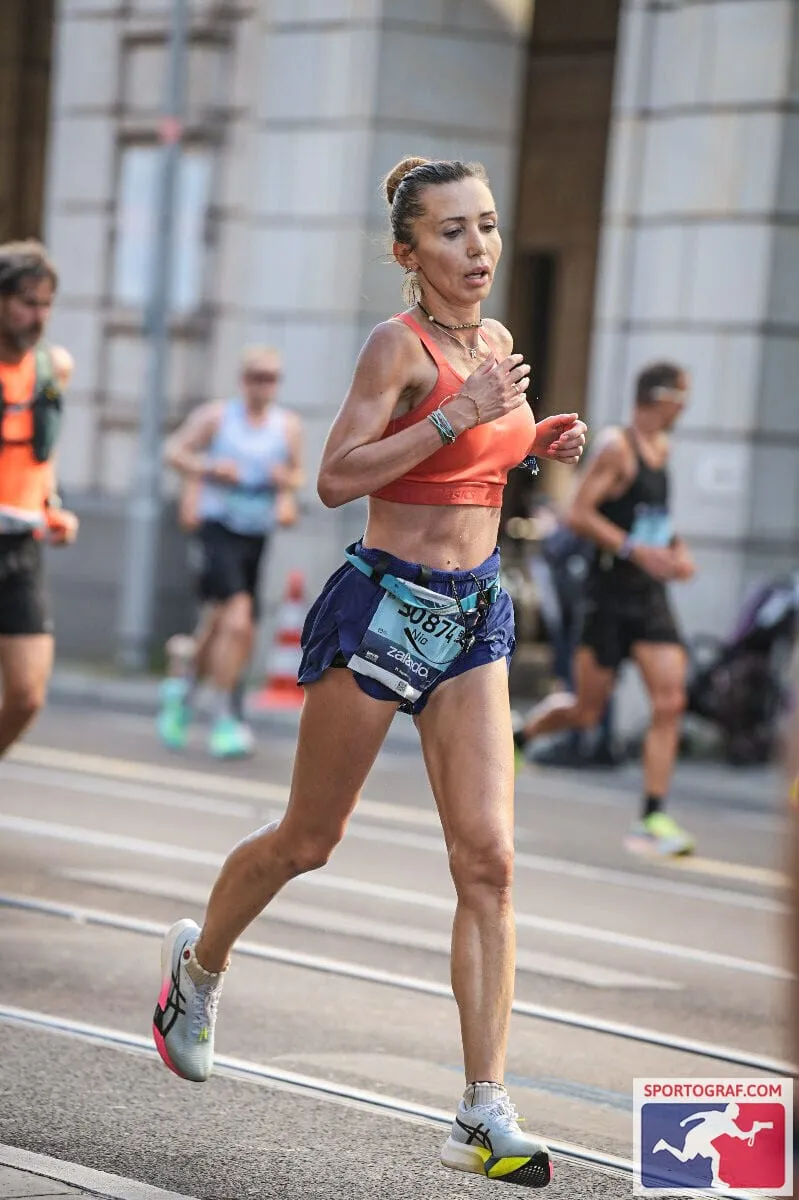
The power of a spousal telling-off carried me all the way to the 35th kilometre. My kids and Militsa, who were following my splits, told me that up to the 35th km I was on course for 3:08. At the 35th kilometre, however, I hit the wall. At least the symbolism is worth it – I hit not just any wall, but the Berlin Wall. My pockets are full of gels, but I can't get them down, and so my glycogen stores stay empty. My legs start to buckle. I start using the water stations as an excuse to stop for a bit. And the only thing that brings me relief is the taste of water. Every sip of water spreads an unheard-of sweetness through my cells – water is the greatest creation in this world, I keep telling myself.
My collapse continues – at the 39th kilometre, I'm telling you seriously, I started seeing myself from above. I carried on somehow, with buckling legs and arms that were now locking up.
I tried to motivate myself with the thought of Nakov, stroking his beard as he looked at my splits on Strava and concluding sagely: “Just as I thought – a classic blow-up.” That picture made me furious enough to squeeze out one more kilometre while I mentally gave him a piece of my mind: (When this guy runs a marathon as fast as I did while BLOWING UP, then he can show up in my subconscious and analyse me)….
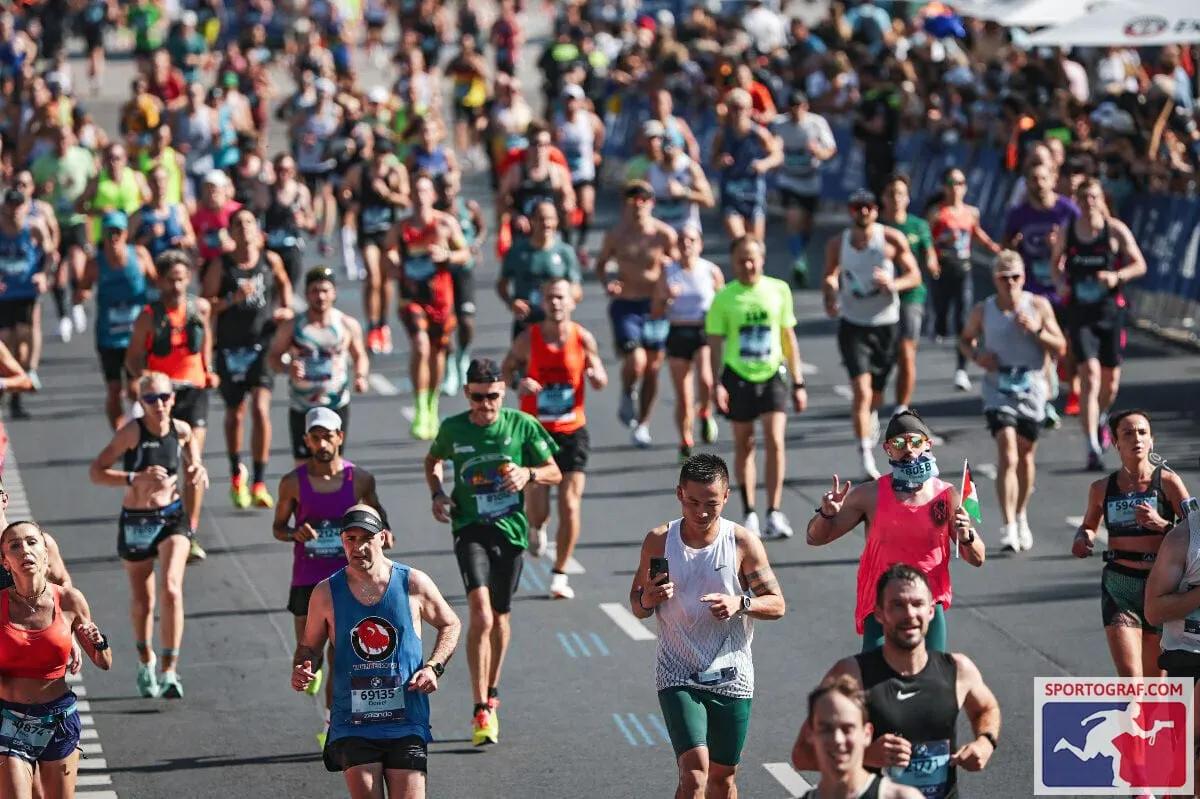
But once I entered the finishing straight and saw the finish arch, I collapsed.
This photo is seconds before that
I sank to my knees and couldn't move any more. Marathon volunteers grabbed me under the arms from both sides, and in my sorry state I took them for other runners.
“Come on, not far to go, you can do it, your time's amazing!” they encouraged me as they held me up (photo). On top of my physical torment (my whole body had locked up in endlessly painful cramps), came fresh worries – these good people were wrecking their results because of me. Instead of giving it everything in a final sprint, they were dragging me towards the arch. If I were in their place, I mused with my foggy little brain, I'd finish first, there's only 100 metres to go, and then come back to scrape the jellies up off the course.
Here are the three of us finishing beautifully together.
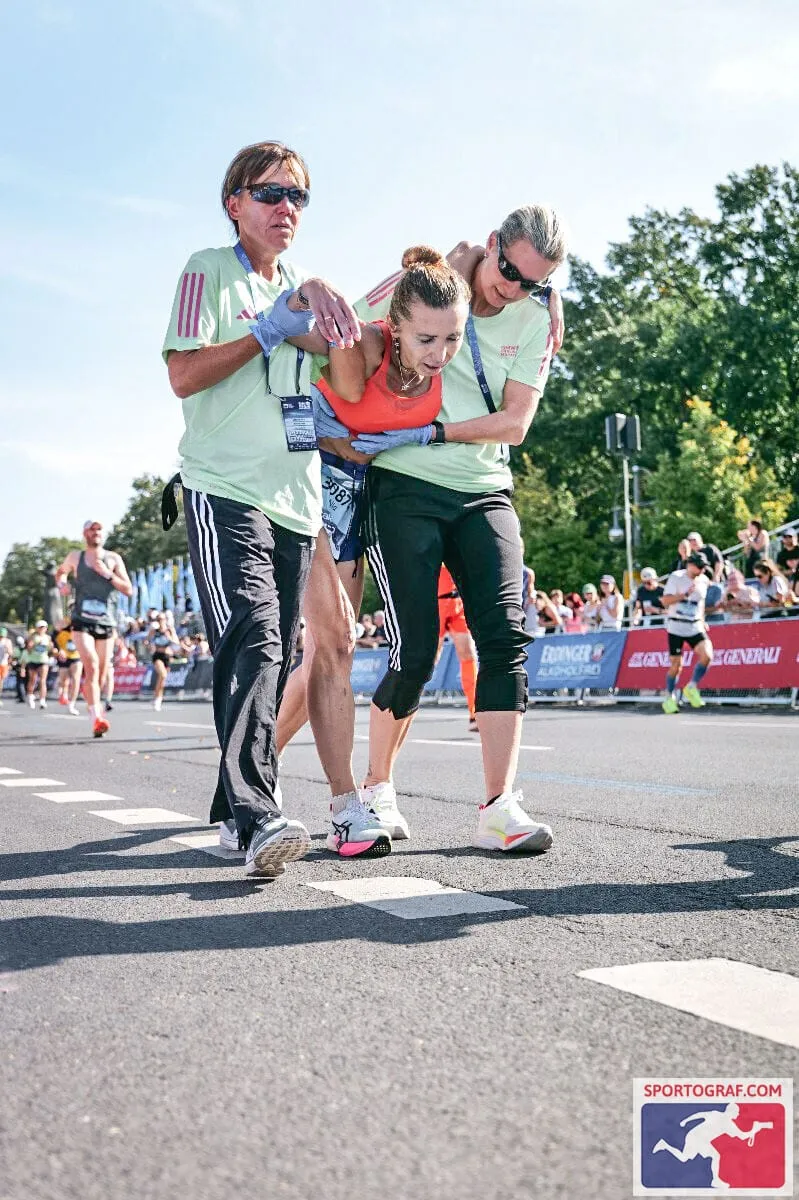
Now at least I can see that they were volunteers and I hadn't wrecked anyone's time, but when I finished the Berlin Marathon, crawling across the finish line, this worry too lay on my martyred shoulders.
I have to hand it to the Berlin crowd – there's none like it – my finish on all fours drew such stormy ovations and applause from the spectators, you'd think it was Kipchoge and Sifan Hassan finishing hand in hand.
In the medical tent after the finish we're a bit like Berlin in the spring of 1945. On every bed lies someone crying, throwing up or passed out. Howls and groans come from every side. A marathon is a battlefield, even if it's a battle with yourself, no point kidding ourselves.
I lie there on my stretcher, cramping away, and think about gamebooks again. Yes, in them we go through a chain of far-from-perfect options, forced on us by the Creator of the game. But in the end, working with what we've got, we still reach the end of the gamebook, which, depending on our choices, is either a victorious finish or death for the protagonist. My time is 3:14:27. It's not the 3:06 I wanted, but I can say that for me the Berlin Marathon ended with a victorious finish.
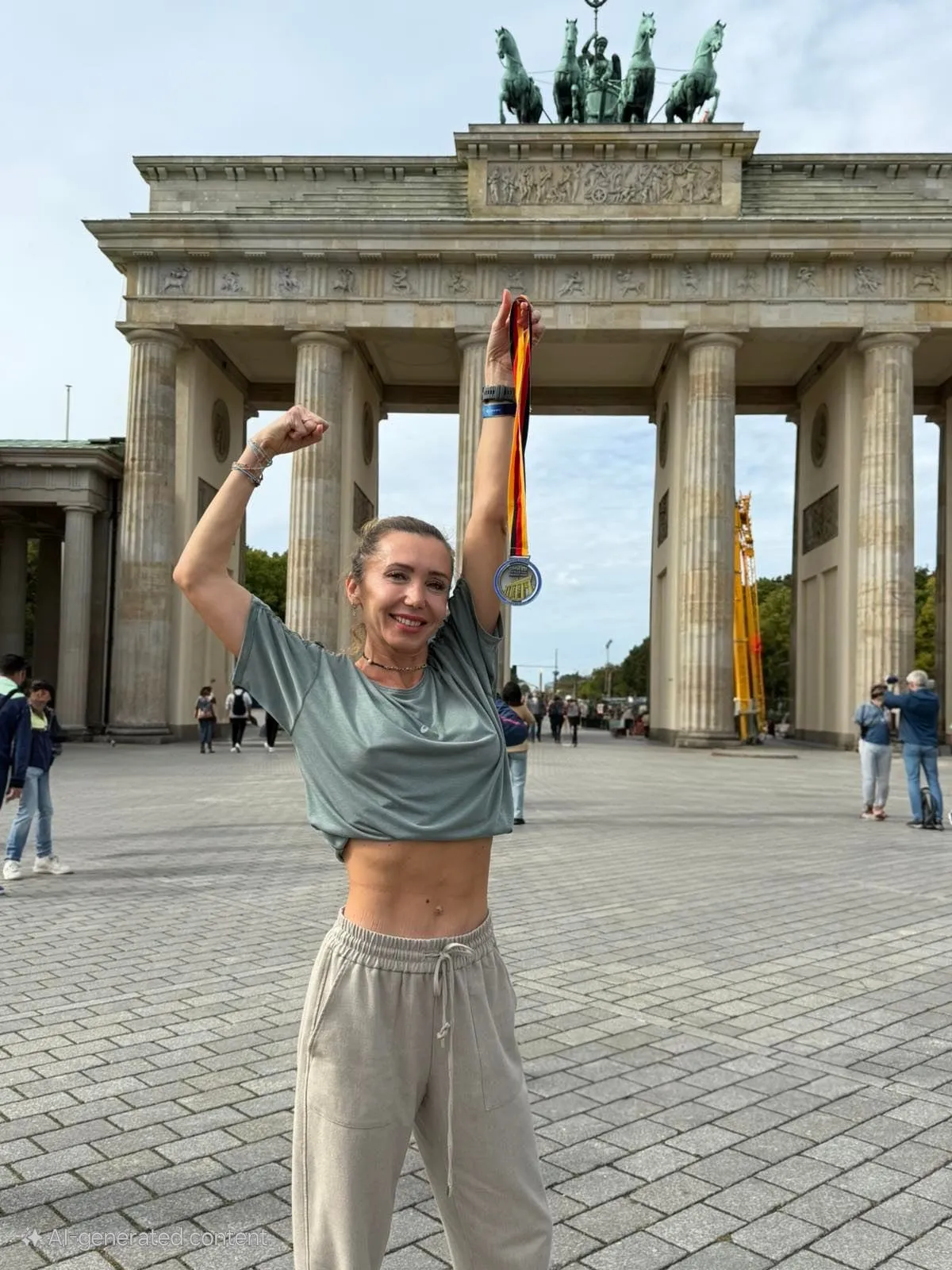
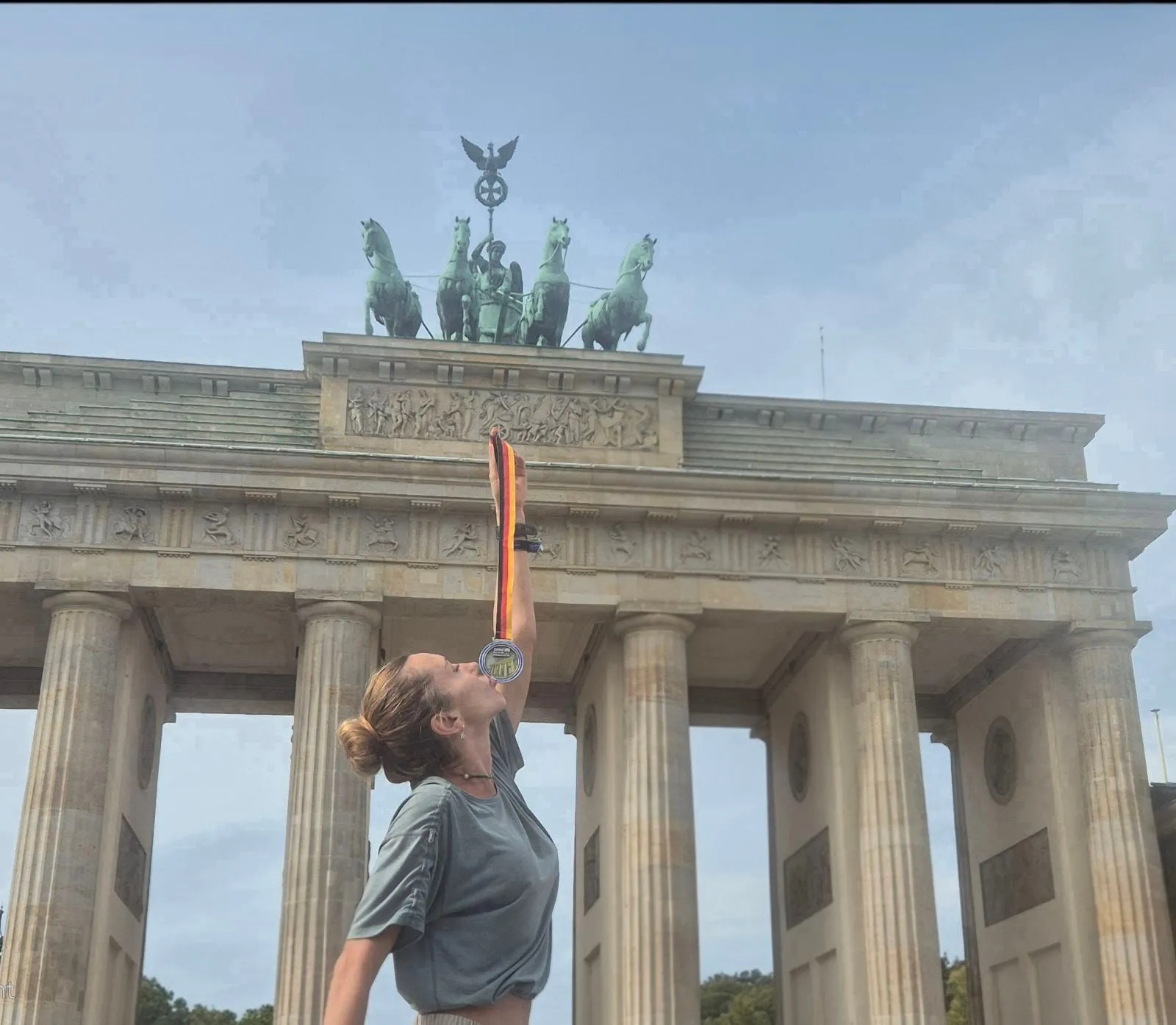
Besides the longed-for second Major medal, I'm holding a souvenir fridge magnet with a tiny piece of the no-longer-existing Berlin Wall. It's been smashed to pieces. I crashed into it, and I'm still in one piece.