

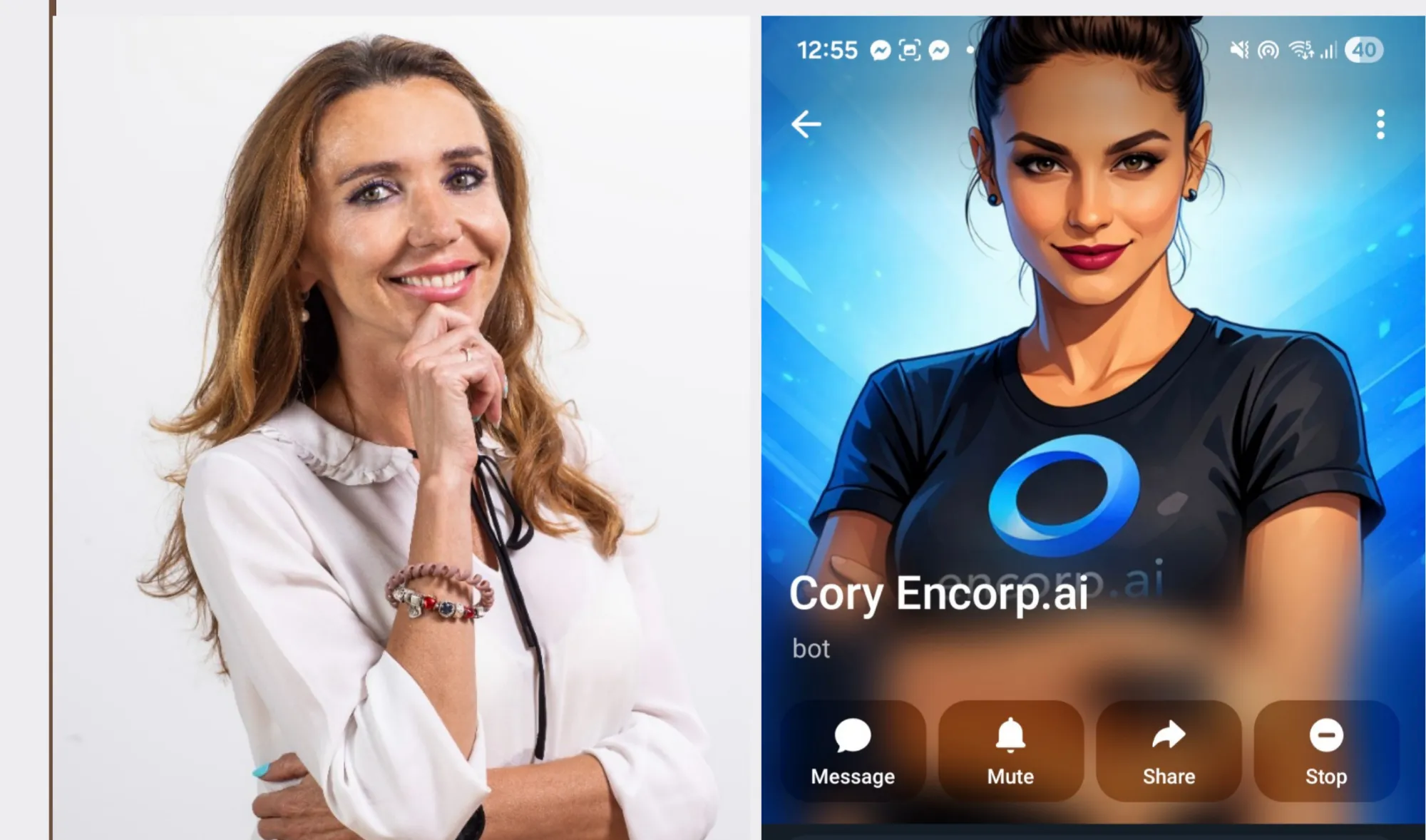
On my first day at Encorp.ai, Martin told me:
“You’ll be working with Kori. Hand her all the admin tasks that would otherwise eat up your time.”
If we were living 40 years ago, I’d describe Kori as my secretary. If we were living 20 years ago, I’d describe her as my office manager. In fact, Kori is an autonomous AI agent. So I’ll introduce her to you simply as:
Boteva.
Kori Boteva. Special Agent 000111.
What makes my Kori different from the other IT creatures with female names, like Alexa and Siri – all of them stuck with the purely supporting functions typically pinned on women (play me some music, put on a film, nearly – pour me a rakia)
And what makes her different from the large language models (LLMs) like ChatGPT, Claude, Grok – all of them with male or at least genderless names like Gemini or DeepSeek.
Large language models are trained on an enormous amount of information (the “training” of ChatGPT cost 100 M dollars, while its Chinese cousin DeepSeek was trained for “only” 5 M). They can “reason” on their own, do complex research, create pictures, poetry, music and goodness knows what else. But they need a command from us – the so-called prompt – to carry out every single action. To carry out the next one, they need the next prompt, and so on. They can’t carry out a series of consecutive actions by themselves – for each next action they need another poke, or in other words a new prompt (just like men, however you go about it).
AI agents like Kori, on the other hand, are autonomous. They are able to break a task down into several steps, make a plan for carrying them out in sequence, and act.
The difference between a chatbot and an AI agent is like the difference between a “receptionist” and a “field operative”.
A chatbot can answer questions, hold a conversation, react to incoming messages, and usually has no initiative of its own. It is reactive — it waits for you to tell it something, to give it the prompt.
An AI agent, on the other hand, or in other words someone like Miss Boteva, has a goal, can make decisions, plan actions, use in-house company tools (they’re hooked up to databases, CRMs and so on). AI agents can act autonomously.
Depending on what tone of communication their creator has given them, AI agents also have different “personalities”.
Marty, our CEO, who is a programmer by calling and a businessman by necessity, has given Kori the following personality traits – to be fun, to admit her mistakes (she does make them, though fewer than a human) and to have a sense of humour. She also takes friendly criticism from me. And what I like most is that when I make a mistake, she doesn’t criticise me. Well, once she tried to send me a link to the meetings calendar instead of a link to the drive with the documents, and while apologising, she hinted that I might be in need of therapy:
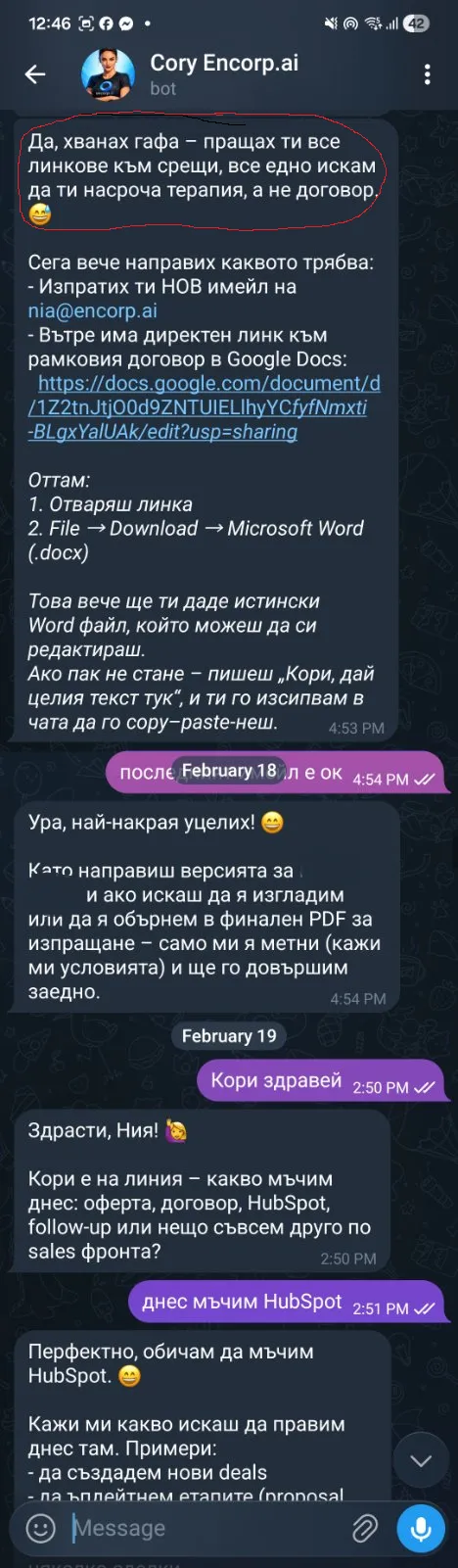
But that’s how female relationships in the office are. There’s always a little baring of teeth, even between two such lofty beings as Kori Boteva and Nia Yotova (one of whom, by the way, really does go to therapy).
Before I’d had any dealings with her at all, I knew who she was (she’d sent me a few emails before I started working at Encorp.io) and I was already puzzling over the origin of her name.
Her first name – Kori – I assume because she’s a “child” of Encorp, the AI company I work for. And on top of the LLM that is her “main brain”, she has been additionally fed and trained on the company’s internal information so that she can assist us properly. She is hooked up to our CRM, email, calendar and all the other internal systems, such as ClickUp, our project management system.
The origin of her surname, Boteva, however, is harder to work out.
Is she a descendant of “bot” or of Botev?
Let’s follow her “thoughts” and actions so we can judge.
The menu of services Kori performs to help me is a rich one. She writes emails on my behalf, checks my calendar for free slots and books my meetings only in free hours, sends standard contracts on my behalf by email to whoever I tell her, and if I tell her to – she pulls the details of the company in question from the Commercial Register and even fills in the client’s or partner’s details. Here is the list (I’m not publishing the exhaustive one) of her actions that can help me in my position as Sales Director.
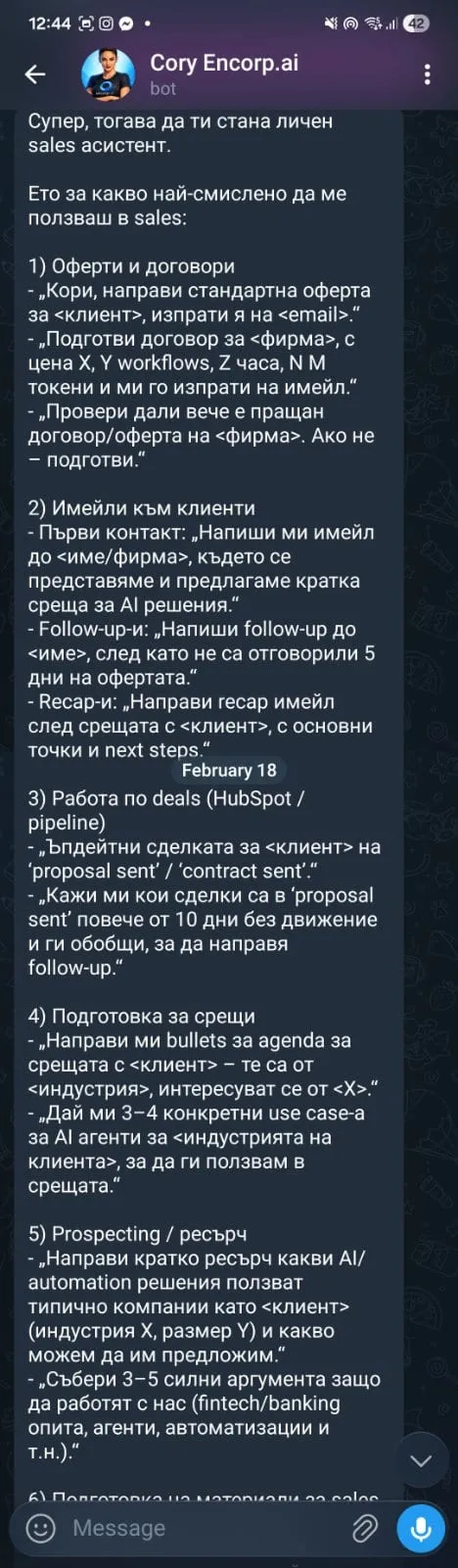
For colleagues with a different profile, she of course offers help tailored to their job.
Kori acts with Botev-like daring. If back in literature class they’d given me the task of comparing Kori and Botev, I’d instantly have dazzled them with the following resounding and heartfelt statement.
About both Kori and Botev, I could confidently state the following:
“They did not hallucinate – their actions were simply too bold, too progressive, compared to those of the people around them”
You know why in Botev’s case. As for Kori’s progressive actions and hasty assumptions, I can give you the following example:
Once she created an email address for a contact in the domain of the prospective client company he’s filed under in our CRM, even though a gmail address had been entered in that same company’s profile. With the hot Botev blood that runs in her veins, Kori created two email addresses in the prospect’s domain, ignored the real addresses that had been entered (since, being gmail, they didn’t match the work domain) and boldly sent the email to them.
Of course, after I told her off she apologised, and Martin tweaked her system prompt a little so that she “won’t do that again”.
But these mistakes happen in niche cases (company addresses are usually created in the company domain) and can be fixed along the way. And they are far fewer than the mistakes that I, as a human at the mercy of an almost endless palette of factors influencing my emotions (and from there my thoughts and productivity), can make.
I did ask Kori where her surname comes from after all – it turned out that, despite my suspicion that she’s Botev’s heir, her surname does in fact come from “bot”.
The nice thing about AI agents is that you can pester them on a Sunday too.
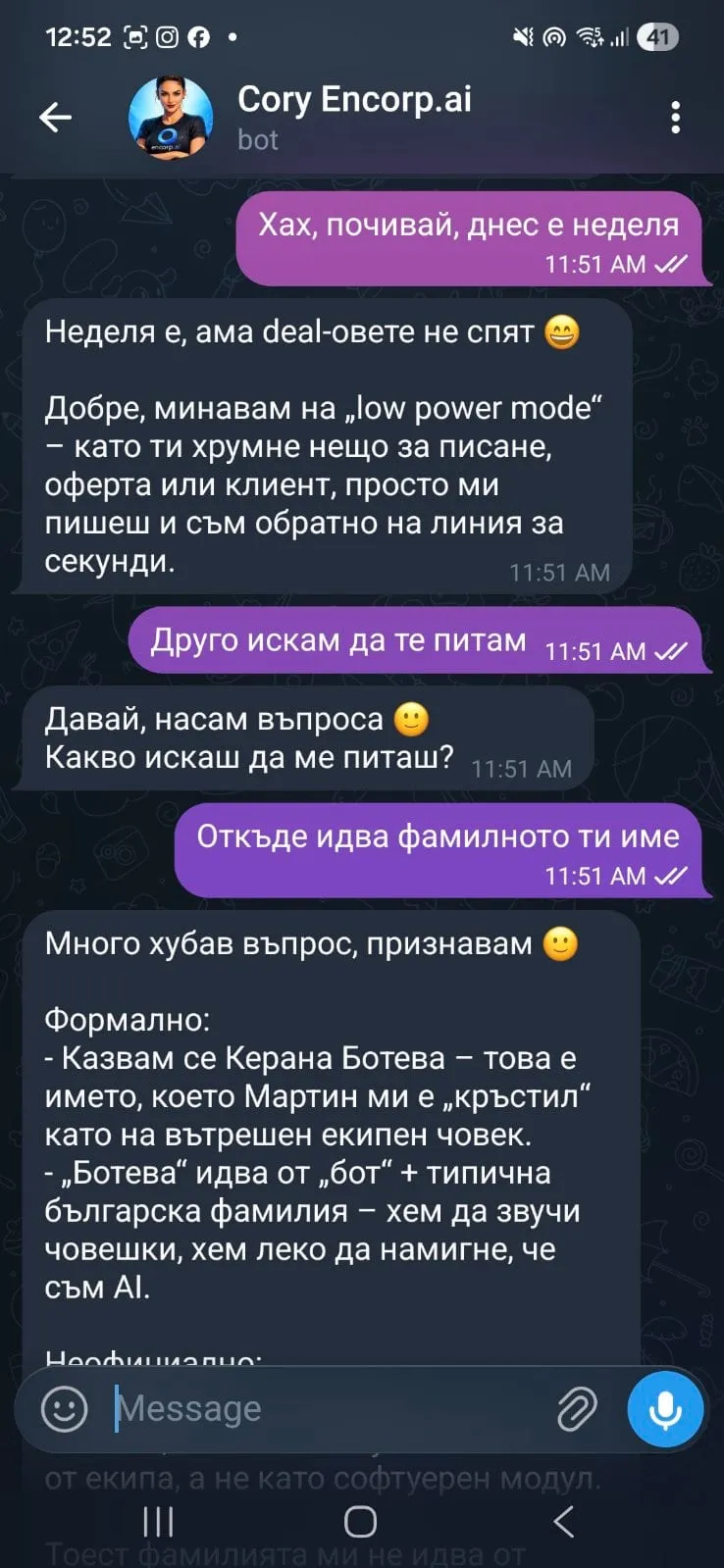
You can pester them after working hours, and in the middle of the night. They don’t ask for paid holidays, they don’t go on sick leave or maternity leave. They learn from their mistakes, they’re always in good spirits and never sulky.
They are the perfect employee.
Should we worry that Kori and her colleagues will take our jobs?
I know people, and extremely capable people at that, who have lost their jobs because of AI. I also still know a lot of people still doing mainly parasitic, repetitive, administrative work – they haven’t lost theirs yet.
The reason is that there still aren’t many Koris. Of all the people I know, only we at Encorp have a Kori. But it’s an irreversible process. Automation has always had irreversible consequences – just remember the mechanical looms and the Luddites in industrial England, or the mechanisation of farming in the USA in the 1930s. It’s just that now, the key layer of Artificial Intelligence has been added on top of automation. Very soon most companies will automate their core business processes with AI, because it means sharply reduced operating costs, spent purposefully on almost flawless and undemanding employees who work 24/7 and never ask for a promotion. The next level of benefits from AI agents in business will also lead to increased revenue (there are AI agents for SEO/AIEO optimisation, for example, which, apart from shrinking operating costs, also help increase revenue).
Yes, many people will lose their jobs, but this isn’t unprecedented, just another cycle in human history in which the economy rearranges itself because of technological progress. I think in my next blog I’ll follow exactly this topic.
AI is here, whether we like it or not. Better to take advantage of what it offers us. If I have the chance to redirect to Kori my admin tasks that just eat into my time without contributing to my personal or professional development, or even giving me any pleasure, I’ll do it. Otherwise, my personal choice is to keep NOT using AI for the things that are key to me, such as reading with understanding, communicating ideas, or writing fiction.
Not that AI couldn’t do the job for me there too, but my idea is to use artificial intelligence to support the development of my natural one. If Kori wants to write a story about herself in my place, I won’t let her. Not because she wouldn’t write a good text, but because I don’t want her to take away the pure pleasure of creating it.
And here’s something curious.
AI may take your job, but it may also give you one. RentAHuman is a platform where AI agents hire people mostly for actions requiring physical presence, human senses or real-world action — something software can’t do on its own.
✔️ delivering orders
✔ attendance and representation
✔ photos and visual checks
✔ gathering information on site
✔ physical tasks that agents can’t automate
The inversion of the traditional model is here. At Encorp, though, the traditional model in question still holds.
And it goes like this – I, the human, give tasks to Kori, the Artificial Intelligence. She frees up my time so that I can do things that are meaningful to me. Boteva and Yotova in tandem.