
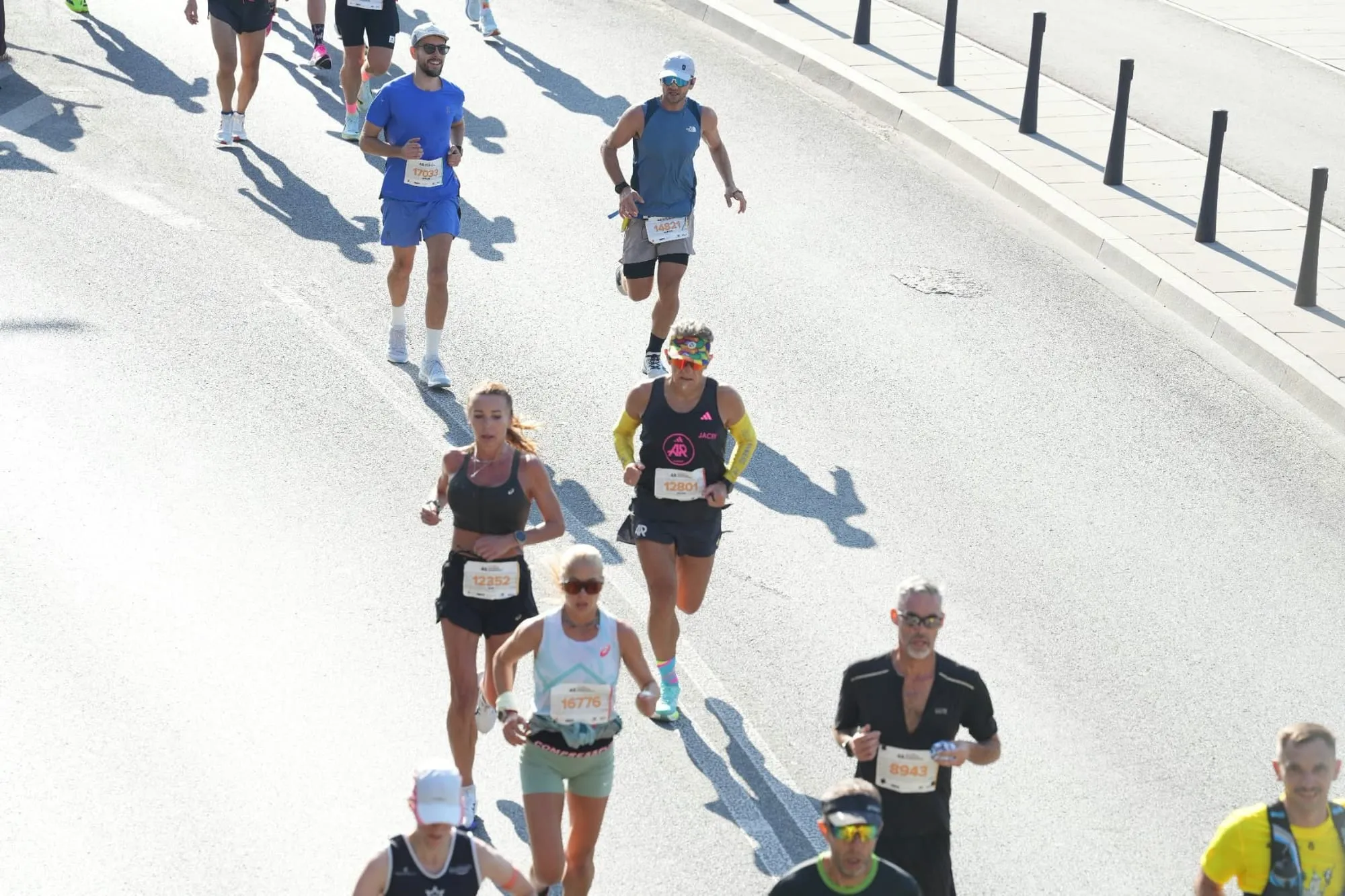
On 27.09.2026, within the space of 5 minutes, the universe tilted at a very particular angle, a black hole began to swirl in it, and out of it tumbled the following two theoretically impossible things:
1.I posted a photo of myself on Facebook, dressed head to toe in Nike
2.Straight after that, Asen Lilov phoned me and said “well done!”
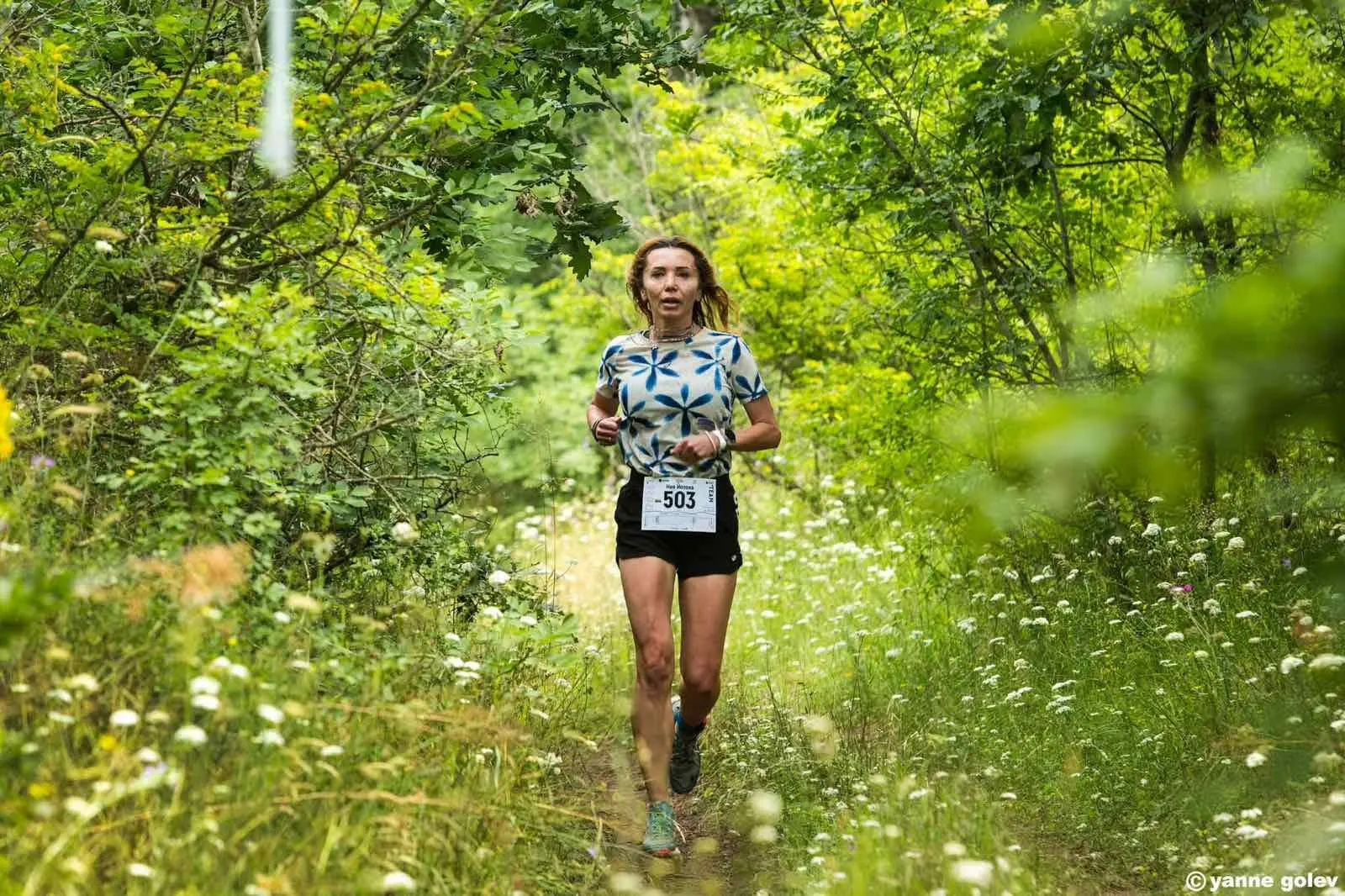
Although Asen is a Nike fan, there is no direct link between these two events. His “well done” was about my result at the Warsaw Marathon, which I had just finished with a personal best of 3:11:36. But they make a good starting point for unfolding today’s blog, dedicated to reflections on: “what is this thing called the impossible, and does it have a leg to stand on round here”.
Let me first introduce my mate Asen. He is the biggest hater I know personally. I can think of 1–2 who are worse than him, but those I only know from afar. The paradox with Asen is that, for all his hating, I have a real soft spot for him. I don’t know whether it’s because he’s a Leo, and my warm feelings towards Leos come by default, or because, unlike your typical hater, he at least has a realistic idea of his own personality.
We’ve run together now and then. I remember a 10 km race in Pleven last year. Asen made a dazzling guest appearance there in an elegant little yellow vest and Nike shorts. On his feet, quivering in anticipation of a triumphant gallop, glowed, uncompromisingly, a pair of bright pink carbon shoes from the same brand. Proof of the good heart beating beneath that alpha-male fluorescent exterior was the fact that he sacrificed his own race to help me. Halfway round the course I fell on the tarmac and opened up a gushing wound on my knee. Asen waited for me to dust myself off and, with the encouraging words “look at that bloke and that woman, they’ve practically stopped, it’s unbelievable, even a tripped-up auntie with a split knee like you should be able to overtake them”, he towed me to second place among the women.
Once you get over the shock of first contact with him, for some mysterious reason you become friends. Ask the not-unknown Maria Popova. Her first head-on collision with Asen took place at a sports weekend in Belmeken. My mistake was leaving Maria alone with Asen without warning her that a close encounter of the third kind awaited her. After half an hour without my supervision, I found her pale-faced, curled up deep in a corner of the little bar, silently calling me with a helpless look. She was blinking SOS at me in Morse code over Asen’s shoulder. He, for his part, was leaning over her, passionately holding forth on a topic utterly inappropriate for getting to know someone new. Namely – the inefficient running technique and compromised training of Nia Yotova.
A year and a half has passed since then, but Asen still digs around in Strava and gets cross about how I skew my heart-rate stats by stopping to chat with people in the park in the middle of my easy run. On the basis of those same Strava analytics, he had drawn up apocalyptic forecasts for my performance at the Warsaw Marathon, which took place on the aforementioned date of miracles – 27.09.2026.
I disproved Asen’s sinister predictions by setting a personal best a minute and a half faster than my record of 3:13, which had been gathering dust for 3 years. I didn’t hit my target time of 3:10, but I was still very happy.
I was happy because with this run I achieved a third impossible thing within the said 27.09.2026.
The most important one for me.
Besides Asen, I disproved myself.
By improving my marathon record from three years ago, I empirically rejected the thought hanging over my head like the sword of Damocles – that I would never again be able to improve any of my personal bests, because I’m getting old.
That was my opinion, which I resignedly accepted as fact. Learning to tell my own opinion apart from objective facts is one of the things I’ve been working hard on this year, under the guidance of the psychologist Vlado Novkov.
It is a fact that I’m getting older. It is also a fact that a person in peak physical shape in their youth will start to see their results decline with age. Automatically, from these two facts, I derived a false postulate about myself – from here on, I’m only going to get slower and slower.
I completely failed to take into account that I, being an amateur, have never, ever been at the peak of my physical abilities, and that automatically excluded me from the pessimistic calculations. If 3 years ago I was at (say) 40% of my abilities, and now I’m at 45% of my current abilities, I’ll still be improving. For the last few months, consciously working on my own thoughts, I had been trying to convince myself that this should be my guiding attitude. But I badly needed some empirical proof that I was on the right track. As the saying goes, seeing is believing.
Or in my case, the legs have to run it for the brain to believe it.
Which is exactly what happened, thanks to the help of Monika Filipova, who was my pacer, but more on that a bit later.
Continuing to follow the thread of the supposedly impossible, I go back to the start of the blog – namely the other impossible thing – the photo of me in Nike kit.
After the finish of the marathon, happy that I had managed to disprove my own prejudices, I naturally wanted to celebrate. People like me celebrate by announcing their result with a little photo on Facebook.
The photo I chose to announce my own triumph was a bit of a compromise. Not in terms of exposure – exposure-wise it was perfect – I had never seen my stomach in such a flattering light. What was compromised was the format of the photo, because Huawei, who sponsor the event, photographed me in front of a screen showing my time on one of their branded walls and then gave me the photo as a present. ON PAPER.
As I’ve already mentioned, I was so taken with my own abs in this photo that I didn’t want any other. Emo, always on hand when a problem of mine needs solving, offered to scan it with ChatGPT’s image generator. The idea was that, once scanned, I’d post it on Facebook and then maybe we could finally sit down in peace for a well-earned coffee.
“Are you sure it won’t come up with a label like ‘AI content’? I don’t want anyone getting the impression I’ve sculpted my abs with AI.”
“Listen to what I’m telling you, nothing will come up,” Emo assured me.
He’s my husband, so, as always, I shut my mouth and did as he said. Still, I gave the photo a quick once-over – I didn’t notice anything strange.
I posted it on Facebook. No label appeared saying there was AI involvement in the image… I had no time for more detailed inspections, because one of the shining moments of my life was approaching – I saw an incoming call on my phone with the name Asen Lilov.
I have been waiting for this moment ever since we met 2 years ago. Of course, I pressed the green receiver to savour the validation of my life:
“Well done, sis! Considering your advanced age and your measly mileage, you ran a lot better than I predicted.”
My happiness lasted no more than a second, though, because he went on – “and I don’t know what kind of ASICS captain you are, but in the photo you posted from the marathon you’re dressed head to toe in Nike”.
I hung up on him hastily, only to find my Messenger flooded with messages – most of them congratulating me on the run, but there were also a few warning ones, such as:
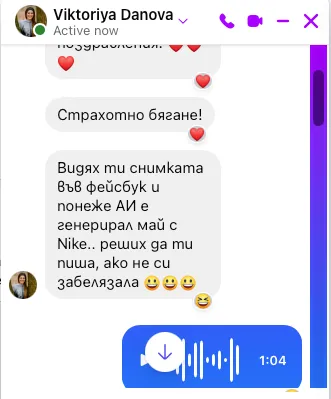
For someone who has been representing ASICS for seven years now, this is unacceptable. Even more unacceptable because it never happened in real life! I ran as I always do, dressed in ASICS.
What had happened, you ask? A few days later, at the office, my colleague Mitko decoded the “miracle” and explained it to me.
A scanner copies a photo dot by dot.
ChatGPT, however, doesn’t copy pixel by pixel. It looks at the image, recognises what’s in it (“runner, sports kit, medal, finish”) and draws a brand-new picture from that description. The clear details like the face and the pose it recreates faithfully. Where it can’t see well, it fills in with whatever is most likely according to the billions of photos it was trained on, in which a “sports logo” is very often represented by Nike. This is called a hallucination.
I fixed the photo blunder quickly. First Emo issued an urgent command to the chat to put the ASICS logo on the photo – another prompt mistake, because the AI slapped two huge ASICS logos on my crop top – one for each of my boobs, so that nobody would feel left out.
The apocalypse Asen had predicted passed me by during the run, but it could have materialised now, if our marketing manager Vesi had been scrolling through Facebook at that moment. Since I didn’t get a message from her saying: “What’s going on here?”, I concluded that she wasn’t online at the moment and used the chance to head off the crisis. I replaced the compromised photo with one from the phone of my son Nikola, who had been taking pictures alongside the Huawei photographer. True, in Nikola’s photo my abs were less defined and my time on the screen was blurry. But at least nobody had hallucinated over my picture.
What a wonderful parallel, though, between the logic of artificial intelligence and that of my own brain. One of the leading theories in neuroscience describes the brain as a “prediction machine”. In his book “Being You”, Anil Seth calls human perception a “controlled hallucination”. Just like AI, my brain doesn’t perceive the world afresh each time, but constantly fills it in with expectations built up from experience. If I keep showing it people/events that contradict what it expects (and my brain has a tendency to catastrophise), it may loosen its grip on my abilities, or more precisely on my perceptions of my abilities.
Which is actually what it did in Warsaw.
The truth is that in Warsaw I trained my perceptions for a full 3 hours and 11 minutes with the best possible “medicine” for my prejudices about the effect of age on women.
Monika Filipova.
There isn’t a person in running circles who doesn’t know who she is and what she can do. She has a sub-9-hour Vitosha 100 and a heap of other trail achievements that I can’t list, but I know that at whatever race I’m at, she comes in together with the first 5 men. Since I’m not especially excited by trail, I couldn’t quite translate what that means in “tarmac metrics”. Until Monika turned up in South Park to try 5 km on tarmac for the first time in her life. That winding course, tough in its first part, she ran in 18:25.
A woman of 42!!!
Exactly the person I needed to show up in Warsaw the day before the marathon and tell me that she wasn’t going to push, she’d just be doing a long Sunday run. From a run of mine back in May with my idol Nadezhda Angelova, I had established that when there’s someone to pace me, I switch off all the “defences” my brain builds and simply follow my pacer. The result is that I run much better than usual. And the effect on me is multiplied many times over if that pacer is a woman over 40.
What can I tell you about the run itself? One woman’s easy run is another woman’s personal best.
I told Monika I wanted us to hold an average pace of 4:30. She didn’t have time to take her jacket off and set off with it tied round her waist. As the run went on, little by little she started filling her pockets with my things. For instance, a bottle of gels of mine which, on the move, I discovered I couldn’t squeeze into my mouth, so I had to unscrew it and try to aim my mouth at its contents flying through the air. After several unsuccessful attempts, I gave up on this innovation – the gel bottle. It was, however, revoltingly sticky from the spilt contents. Where do you think I left it? With Monika.
Every 5 km there were water stations. If you’re running a marathon, you absolutely must drink water at every station. So that I wouldn’t lose time, Monika would barge her way through all the runners who were stopping and grab 3 cups of water. Not one, not two, but three. The first she gave me to drink on the spot. With the second she poured water over my head. And the third she carried until the next kilometre, when it was time for my gel. (For the non-runners who’ve made it this far – a sports gel must always be taken with water.) My target pace was so easy for Monika that she killed time by trying to carry my water from the station for a whole kilometre without spilling it from the tiny paper cup.
There was a moment, around the 30th kilometre, when I felt I was starting to fall apart. I couldn’t imagine holding this pace for 1 more kilometre, let alone 12. I told myself to stop thinking, stop analysing and just follow Monika. I avoided looking at my watch, but every time I did glance at it, the pace was 4:30. Not Monika – a metronome.
At the 40th km I hit the wall. Monika started explaining some numbers to me, something about 40 km in 3 hours, I had time in hand, I was a great machine, but I could only hear and see in snatches. I began to feel I was about to do “a new Berlin”, that is, to collapse in the last kilometre of the marathon.
Monika may have sensed the functions in my body gradually shutting down, because she pulled out the gel-smeared sticky bottle I had handed her at the beginning, determined to get a calorie or two into me. I’m sorry nobody managed to film the complicated choreography between the two of us, in which, for at least 500 metres, she held the soft bottle like a piping bag, constantly repositioning it again and again, aiming it at my half-open mouth.
The good thing is that, carried away by this intricate dance, we saw the finish arch.
Even better, Warsaw plays fair. Unlike most races, which sneakily parade three arches at the finish and deceitfully lure you in with the first, only for it to turn out that you stop your watch at the third.
Here, as dessert to the flat and easy course, the first finish arch turned out to be the last. Hats off, Warsaw, you’re brilliant!
I don’t remember anything about the finish, but afterwards I watched the video and saw that my pacer gallantly let me finish ahead of her.
It struck me as a lovely gesture, with which the pacer shows respect for the efforts of their “charge”. I compared it with my own pacing of Ani Vancheva a week earlier, when it never even crossed my mind to let her go ahead of me.
But that’s what the stronger ones are for – to be an example to us from here on.
I’m carrying on with my work on breaking down my ossified perceptions. It isn’t easy, it requires conscious daily work on myself. But I think that if AI improves by getting things wrong and correcting itself, my brain can do the same, as long as I show it enough “Monikas”.