
Of all my mother's stories about my birth, there's one thing I remember most. How every time she glanced at her wristwatch in the throes of labour (in '79 it was the kind with hands), the big hand and the little hand were ALWAYS on top of each other. In other words, she happened to remember to look at her watch roughly every hour and five minutes.
After I was born, the phenomenon of the overlapping hands died away. This detail impressed my childish brain only because, as I saw it back then, it meant the watch was hinting that a super special child was being born.
And growing up, I somehow always thought that clocks, those pillars of time, were the connecting link between us and the other side.
Years later, for example, as a teenager with barely any interest in anything except discos, I spent hours looking at Salvador Dalí's paintings, and one of them in particular. It's called “The Persistence of Memory”, and in it three clocks with hands melt helplessly, the way a piece of Camembert would melt in the afternoon sun. (picture)
What the artist meant, I don't know (other than that the painting really was inspired by a piece of cheese melting in the heat). But my teenage self thought it showed the clocks' despair at their own inability to show the true nature of time. Not just time as we understand it – seconds, minutes, hours, weeks, months and years.
But the time that flows differently on other planets, and in other dimensions. The time which, according to science-fiction films, is fluid, so we can jump back and forth in it. Whether to fix our mistakes by travelling into the past, or to carry important messages to the inhabitants of the future.
The time that links arms with space, and at the point where they intertwine we can touch other dimensions – the ones we come from and the ones where our souls go on living even after the body dies.
Because I've heard many people tell how clocks stop when someone dies. As if they sense that something is happening so important that they can't express it through their ticking. How true that is, I can't vouch for.
But I can tell you the story of my dad, and of how the clocks behaved, and some of his own stories, around the time he left us. Yes, I know it's probably a series of coincidences, but when you lose a parent, you find enormous comfort in metaphysical signs.
For the last few years I'd always thought my father was a happy pensioner. OK, not exactly happy, since he had two vices – beer and cigarettes, the latter of which is what killed him.
But happy nonetheless, in his own way. He had a wife, children and grandchildren with whom he'd built a very strong bond. He spent all day happily smoking at home while tapping out his latest story on his laptop. He always came across as being in a good mood and ready for a joke.
When he sent me 2–3 of his stories 4 years ago, my heart sank. In my opinion they were really good, and on top of that very funny. But based on my recently acquired experience of Bulgarian publishing, I knew nobody would pay any attention to the stories of a poor balding grandpa, however kind, sweet and likeable he was. Even if he were the next Wodehouse, no publisher would give him a second look anyway.
Actually, someone did give him a look. I sent one of his stories to the well-known Maria Peeva a.k.a. “Mama Ninja”. She liked it a lot and started regularly publishing his stories, for which I thank her from the bottom of my heart. One of the great joys of his last years was exactly these publications, which he looked forward to impatiently. I could see how excited he got about the reactions of Maria's followers.
I noticed how he counted his likes, reactions and shares and how he took the negative comments personally, which, however few, did exist. I taught him that this was normal.
“You can't please everyone, Dad, that's part of the experience of giving life to a text of your own. You're the parent of the text,” I liked to explain to him in my best mentor voice, “and you do with it what you did with your children: you let it fly freely among people, without loading it with expectations. It's guaranteed to reach whoever it's meant for in the end.”
Then, 3 years ago, for his birthday, I offered to make him a website where he could upload his blogs, plus a Facebook page through which we could promote his stories. My brother, who knows about digital marketing, helped me by setting up and launching the campaigns.
His page, “Grandpa Bubi's Stories”, took off really nicely. His target audience defined itself very quickly and decisively. Mainly people his own age, and mostly women. They turned out to be the kindest audience there is. His stories about his childhood, about memories of his youth, as well as his present-day adventures – trailing round hospitals and his scrapes with his grandchildren – were a hit everywhere.
I was personally a big fan of his stories from hospitals and pharmacies. I laughed out loud at his descriptions of his attempts to keep his place in the queue at the doctor's, his heroic battles to stop some other grandpa from cutting in front of him outside the specialist's door, etc. All his hospital stories were cheerful, bubbling with good humour, and always ended with him being let out of the consulting room and told: “There's nothing wrong with you, this isn't the place for you. You're as fit as a fiddle.”
It never once crossed my mind that the happy endings of his stories were completely at odds with the news he was getting at the hospitals in real life; news he was hiding from me, my mother and my brother.
About a month ago I was still living in the happy bubble of ignorance in which my father, despite the several packets of cigarettes he smoked a day, was “as fit as a fiddle”. Whenever we tried to talk to him about his unhealthy habits, he cut the conversation short with the words:
“It's not for nothing my name is Bogomil. I'm dear to God, and the Lord keeps a special eye on me.”
Given his mulish stubbornness about his beer and especially his cigarettes, there was nothing left for us but to hope his name would keep protecting him from himself. Every time the subject of cigarettes came up, he either turned it into a joke or imperiously ended the conversation.
And in the last month things moved at such lightning speed that I can't even put my memories properly in order. First he had pains in his leg because of blocked blood vessels and went into hospital for an operation. The operation was successful, and my father, in his own words, was “as fit as a fiddle” again. The thought flitted through my head like a timid breeze that this luck of his was cheekily endless – blimey, how solid that name Bogomil is. But I didn't doubt for a moment that the story would turn out well.
A few days later he was already so bad that my brother and I had to be told, despite both our parents' wish “not to worry us”. He hadn't eaten for days, he was throwing up everything – not just food and medicines, he couldn't even keep down a sip of water. He had hellish pains in his lower back and couldn't find any position that helped. He'd stand up, sit down, lie down, stand up again, sit down again and lie down again. He wandered round the flat like a restless ghost. No position brought him relief. He hadn't slept for days because of the pain. He'd shrunk even more, and every breath he took came with something between a hiccup and a retch.
We took him to hospital without knowing what exactly was wrong with him. Just so they'd put him on a few drips of glucose, potassium, sodium, etc., so his body could keep up its basic vital functions.
I'll spare you our odyssey of hospitals, paperwork and doctors uninterested in the condition of their patients, since almost all of you have been through it.
Dad's condition got progressively worse, and the latest hospital discharged him in a “visibly improved condition”, to quote the discharge summary. Along with instructions to see a pulmonologist and several other specialists. His objective condition was actually “visibly worsened beyond measure”. Nobody, though, could make a specific diagnosis. For a few days we kept him going by calling a team to put him on drips at home. We knew we weren't curing anything, but at least we were keeping him alive.
Through a friend of his, my brother managed to get him admitted to the Interior Ministry hospital. Thank you from the bottom of our hearts, Lyubcho – you helped our family so much without even knowing us personally!
In the hospital, after a few days, they moved him up to intensive care. They called me to collect his things, and when I took them – a little bag with his ID card, his phone and his car keys – I felt the breath of the inevitable for the first time. I didn't yet know what was wrong with him, and collecting personal belongings from intensive care is standard procedure, but I felt it in my bones as something sinister. I looked at my watch – 19:19.
The next day, at visiting time for updates, the doctor called me aside from the others waiting. He told me Bogomil had a severe form of peripheral arterial disease and severe blood sepsis.
However frightening “blood sepsis” sounded, the fact that we had a diagnosis, and that the diagnosis wasn't “cancer”, calmed me down.
The doctor told me blood sepsis is a very serious condition, but they would cure it. 28 days on antibiotics and the blood would be cured, he assured me. After that we'd look for the cause of the sepsis. But first and foremost we had to sort out the blood, which we could do and were willing to do.
Get on with it, then, what are you waiting for?
Actually, there was one obstacle. Bogomil himself. The doctor told me Bogomil didn't want to stay in hospital, let alone in intensive care. He let me into intensive care, charged with the task of persuading him to stay.
In intensive care he was hooked up to several machines and drips. When he saw me he sprang up nimbly, as far as his condition allowed him to spring. A screen next to his head showed a resting heart rate over 90 and oxygen saturation of 87. I may not be a doctor, but I know what that means.
His legs and belly were terribly swollen; they looked as if they'd been artificially attached to his shrunken little body. The reduced flow of oxygen to his brain had convinced him he was a hero in one of his own crime stories. He had exposed the hospital authorities as intelligence agents who had conspired against him. He wanted to go home “to Druzhba, to Rosi”. There he'd feel safe. With Rosi.
After long conversations I imagined I'd managed to persuade him to stay in hospital.
The next day, though, having forgotten he was staying in hospital, Dad went on fighting to go home. Doctors, nurses and the patients lying with him all seemed to him to be part of the “let's stop Boga going home to Druzhba” conspiracy. The doctors told us they couldn't treat a man who didn't want to be treated.
I didn't even suspect how prophetic their words were.
My mother rang and told me that on her last visit to the hospital, between the stories about the secret services plotting against him, he'd slipped in that 3 years ago they'd found he had bladder cancer. He'd been prescribed treatment, but he'd refused it. He'd told three people close to him; they could confirm it.
Almost sure this story was as true as the conspiracy between the KGB, the CIA and Mossad to stop him going home to Druzhba, I rang one of his confidants. I called him as a formality – I was sure there was no such thing.
The words I heard, though, drove themselves into my heart one by one. It was all true. He showed me the correspondence he'd had with my father, his medical records, the treatment he'd been prescribed. The second opinion from a specialist in Turkey, which had confirmed the diagnosis.
And again – my father's firm conviction that he wouldn't be treated and that he didn't want any of us to know. Cancer cells in older people divide slowly, he reckoned, let alone in an older man by the name of Bogomil. While my mother is talking to me, I glance absent-mindedly at my watch – 15:15
Now it's all clear to all of us.
That evening in the hospital he started pulling childish little tricks on me so I'd let him smoke on the terrace. I let him puff away to his heart's content. It was too late for anything other than letting him feel good, at least for a little while.
There was no longer much point in him staying in hospital either. Even if the sepsis were cured. The problem that had caused the sepsis had already taken over my father's fragile little body with its many tentacles. By this stage every breath he took came with heavy wheezing.
I remembered how, when I was little, he used to tell me a fairy tale about a little girl like me who didn't want to grow up, and so she took a medicine called “Shrinkadol”.
As soon as she took her dose, she temporarily stopped growing and stayed a child. My shrunken, shrunken dad looked as if he'd swallowed a whole blister pack of Shrinkadol, along with the mountains of medicines he really was taking. Besides shrinking physically, the moments when he behaved like a 5-year-old became much more frequent.
The poor darling. I started feeling an acute need to talk to him in diminutives.
I knew there was no point trying to persuade him to stay in hospital, but I still showed him how the drips had helped him. I pointed to his legs and belly, which had been swollen the day before and now, probably thanks to the intravenous antibiotics, had gone back to their normal size.
“Look how much better your little legs and your little tummy are,” I praised him.
Dad sat up and examined his feet and ankles, in their thick socks, with interest.
“They really are better,” he observed. The pride of a 5-year-old whose mum has just praised him beamed out from behind his glasses.
“Well, I think I'll go to bed now,” my dad informed me slyly. He'd put his jacket, his glasses, his phone and his cigarettes right next to him. It was clear he was planning an escape in the direction Hospital->Druzhba, but his roommates had promised me they'd keep an eye on him and wouldn't let him go.
“Off to bed, then, and I'll sit and watch you sleep.” (You won't trick me that easily, you.)
I bent down to kiss him good night, and then he said something to me. He said it with the sweetest grandpa smile and with grandpa cheeks flushed with happiness. Words I hadn't heard for probably 30 years:
“The goodest good night in the world!”
That's how he used to wish me good night when he put me to bed as a child. I don't know from what depths those long-forgotten words surfaced. But at that moment I understood. I understood that for a moment we were swapping the parent–child roles, and that very, very soon our bond would pass into another dimension. A dimension that can't be measured by linear time and clocks.
“The goodest good night in the world!” I planted a kiss on his stubborn little grandpa head. I looked at my watch – 20:20. As if it could have been anything else!
I went home and started mindlessly scrolling through Facebook, trying to take in the day. In the morning I'd thought my father had blood sepsis, and by the evening I was making sense of the fact that 3 years ago he'd had a treatable form of cancer which by now had eaten him away from the inside.
I automatically switched between my own profile and my father's Facebook page. It's called “Grandpa Bubi's Stories” and I run it. The night before I'd grabbed one of his stories “by the ears”, as he used to put it. That is, without reading it at all, I'd taken it from the folder on my computer with his edited stories and published it straight away.
The night before, when I still hadn't known about his three-year-old secret. I looked, as I always do with a new post, at how many reactions, shares and comments it had. I invited the people who'd liked the story to like his page too.
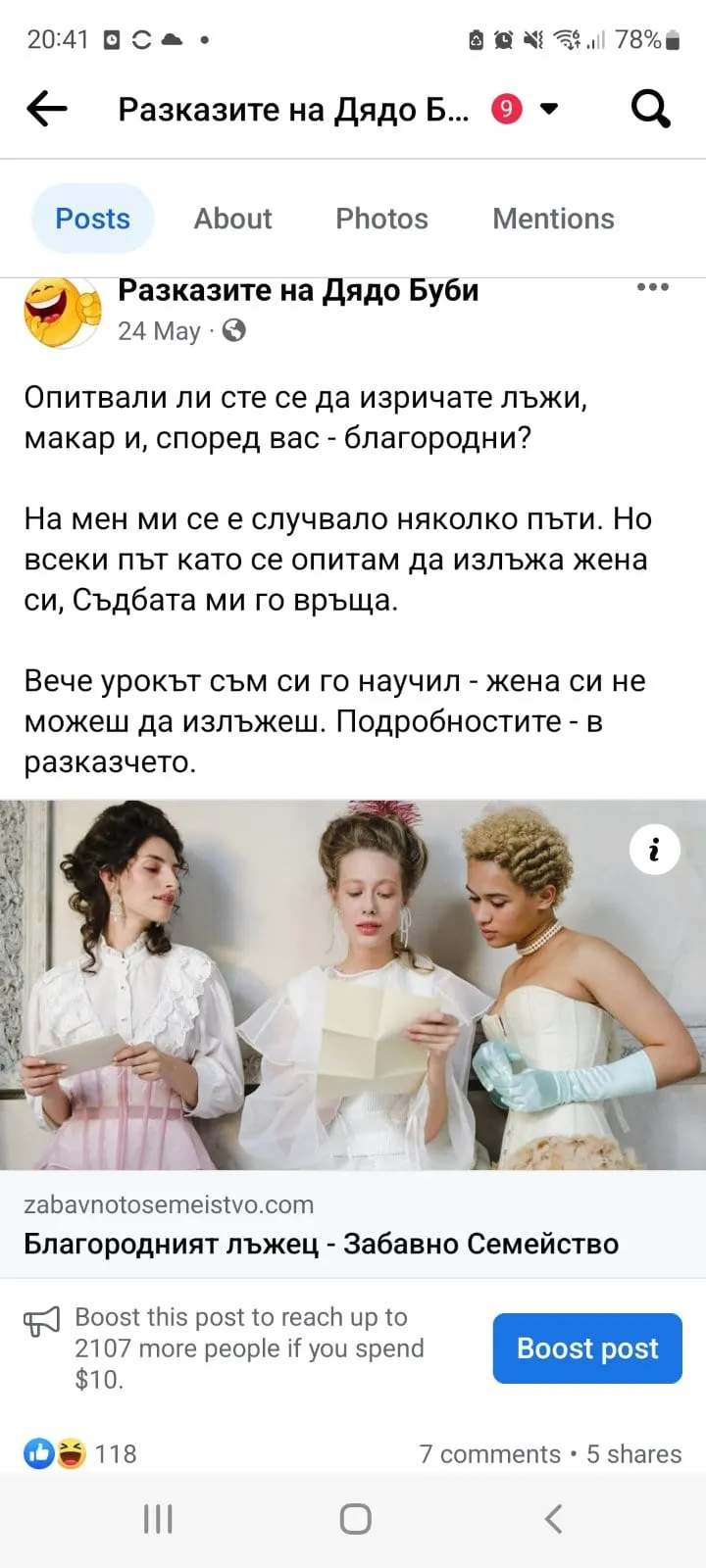
Only then did I take a proper look at the story itself. It was called “The Noble Liar” and in my opinion it wasn't one of his strongest. It described a series of incidents in which he'd told my mother little noble lies to spare himself her disappointment or some family squabble. The story ended with a moral – its main character gets punished for every single one of his little lies.
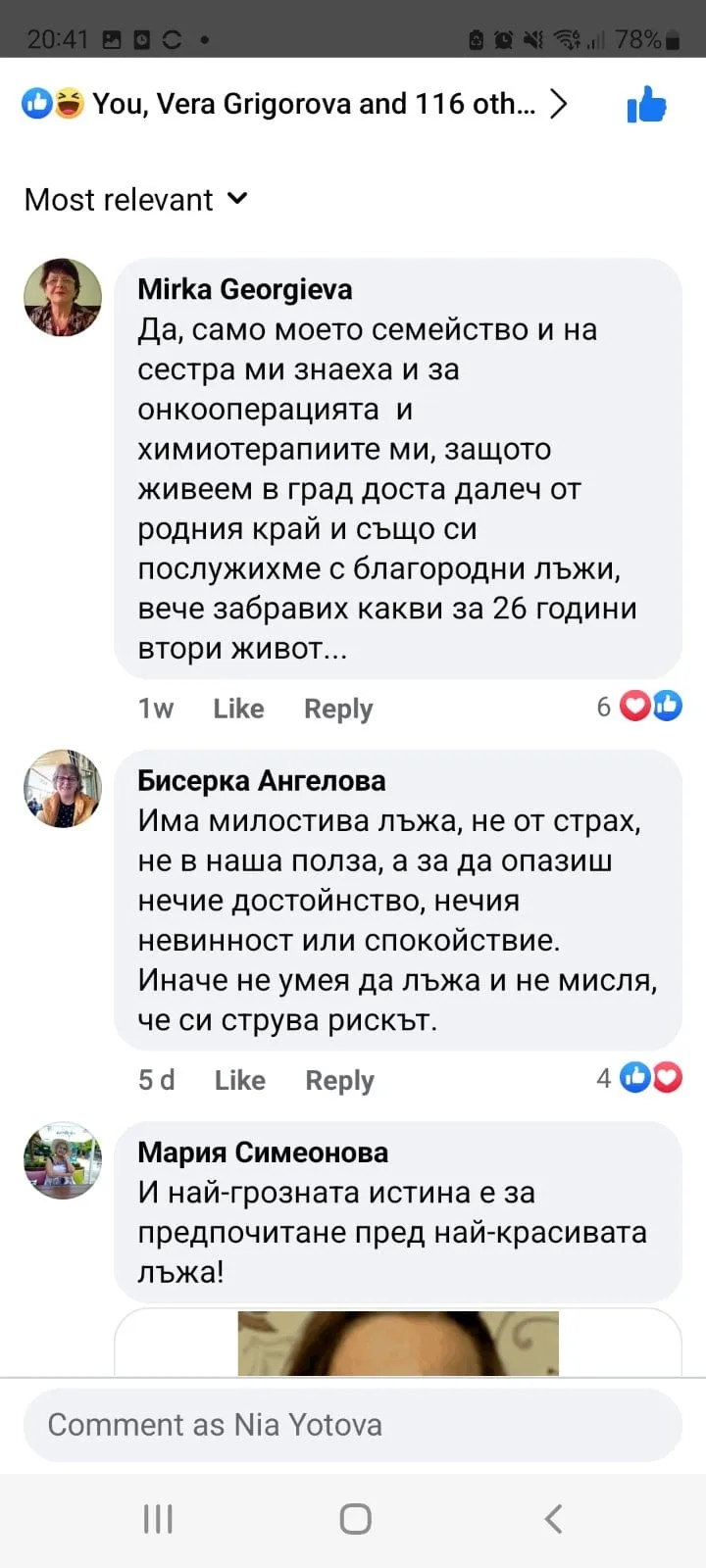
“The irony,” I thought. I'd published his story “The Noble Liar”, and hours later I'd found out about its author's biggest noble lie. But the coincidences were far from over. In the post's intro I'd asked the page's audience, always up for a heart-to-heart, whether they had ever told noble lies too. God, I wrote that intro myself, teasing the audience! I hadn't even known what a huge truth I was writing. Here's the reply from one of the readers:
The next day my father is discharged from hospital and my brother drives him to his beloved Druzhba, to our mother – his beloved Rosi. I go to see him. He can't even speak any more; he communicates by writing. Otherwise he's asked my brother to buy him a cappuccino, and I've bought one too from the little shop outside their block of flats. He raises his cup to me: “Cheers.”
I can't hold back and I ask him why he hid the cancer from us. He gestures for me to give him a sheet of paper and a pen so he can explain. For a long time he scratches away with the pen in concentration, but he produces a text of several lines without a single spelling mistake. In this text he explains to me how – yes, he used to have cancer, but somehow it magically disappeared. He'd shocked the doctors with the complete absence of tumours and metastases in his latest tests. After all, his name is Bogomil.
His eyes, faded by illness and age, look at me reassuringly through his glasses. I don't believe him, but I hope at least he believes himself. And not only does he believe himself, he's making plans for the future while greedily sucking on a cigarette.
“You haven't forgotten we're going to publish my stories,” he reminds me.
“And I'm taking you swimming too,” I tease him. 3 weeks ago I told him that as soon as he got better, I'd take him to a friend of mine to swim, to sort his back out.
“Well, I don't know when I'll be fit enough for swimming,” he says modestly, not joking.
The last thing he said to me before I left was about his brother. I asked him whether they'd been in touch, and he, finding his voice from somewhere, spoke slowly and carefully, pronouncing every word.
“Yees. Pepi rings me every day and every day he tells me: Boga, I love you!”
I go home. The next morning, while I'm making coffee, I get a Viber message from my mother. I know exactly what she's going to tell me. A wave of cosmic calm washes over me. I'm ready.
Boga, we all love you!
***********
A few days after his death I cancel the subscription I'd set up for him on Storytel. My idea was for him to listen to audiobooks, but he didn't manage to get that far. Since I couldn't add a second profile to my own subscription, I'd created a new one for him. I'd completely forgotten what email and password I'd set up, so I looked in a file where I keep such things. I'd created the following email address for him: bogatapower@gmail.com
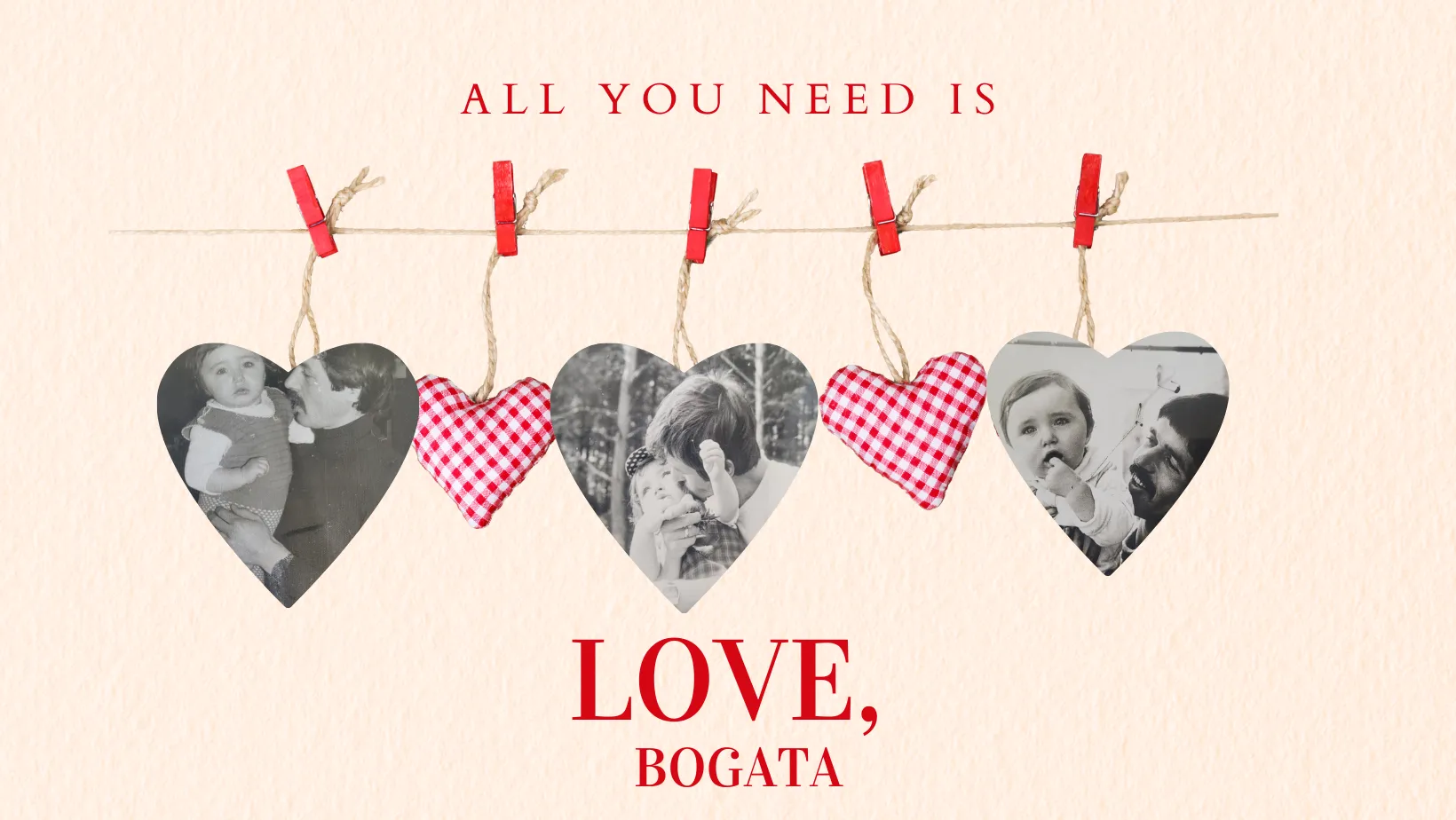
Bogata, with the stress on the “o”, as all his friends called him. For a moment I wondered whether to deactivate his email. Then I decided to leave it, just as I'm leaving his Facebook page “Grandpa Bubi's Stories”. As long as it's alive, he's alive too.
And I'll use his email myself – because I'm bogata, with the stress on the first “a”. Rich, in the sense that I have a lot. I have a father called Bogomil.
Clocks behave strangely when a soul passes from one dimension to another. The hands of wristwatches cuddle up on top of each other. The big one looks after the little one.
And the digits on digital clocks only catch our eye when they match. 18:18, 19:19, 20:20, 21:21…. The clock senses that something is happening and tries to show us that it knows. It knows that time isn't linear but fluid. And Bogomil has simply jumped to the other side of it and loves us from there.