
At the height of the Covid hysteria in 2020 I developed pains around my bladder that got worse every day, and I was going to the loo every 10-15 minutes, even at night. I decided it was down to the enlargement of the prostate gland that comes naturally at my age. Right then, the telly was advertising almost daily a medicine that restored its normal function and, they underlined heavily, male potency too.
In the advert, a man of my vintage kept shuttling between the marital bed and the toilet while his wife watched him anxiously, until at last she pulled out of her handbag a box of the miracle medicine. Soon he forgot all about the toilet, and back in bed the two of them once again had something to do – gaze smiling at the box and nod approvingly. I was sceptical. True, I was peeing very often, but, touch wood, I could still find the odd gap in the schedule for my wife as well. She and I slept in separate rooms, and so that she wouldn't hear me I padded to the toilet like a cat, but she soon discovered that I was often neither with her nor in my own room, and she asked me what I was suffering from – constipation or diarrhoea.
I told her I thought I had prostate trouble. Unlike the woman in the advert, however, she did not produce the magic box from her handbag; instead she ordered me to go to a urologist first thing tomorrow, before it was too late. The next day, at a clinic, the urologist gave me an ultrasound. He flatly dismissed the prostate hypothesis and announced that I needed a cystoscopy, which was apparently a three-day in-patient examination, and that if I wanted, he would book me in for the next day. I agreed, because during the examination he had been pressing on my bladder with something resembling an iron, and it was hurting even more.
That evening, on hearing the word cystoscopy, my wife got worried, whereas I had hoped she would say it was nothing and doctors only did it to cover their backsides. To ease her worry, and mine, I joked that “scopy” didn't mean they'd scoop anything off, it just meant observation, ha-ha. She replied that she was in no mood for jokes and packed my things for the hospital with the air of someone seeing a loved one off on their final earthly journey. She said she had a headache and went to bed. Nothing else came to mind except our standard incantation, the one we used to buck each other up when needed: “I promise you!”
All night I drifted like a ghost to the toilet. By now I had become a dab hand at trickling quietly – I aimed precisely at the slope of the porcelain bowl, even though I didn't switch the light on. As I lay back down, I could feel myself filling up again, as if the bowl and I were communicating vessels. So as not to dwell on this like Archimedes, I plucked up the courage to open Google and found out what exactly cystoscopy meant – from the Greek “kystis”, bladder, and “skopia”, observation – but I read no further. I remembered one of my favourite writers, Jerome K. Jerome, who described how he decided to look up in a medical book what he was suffering from by his symptoms, and in the end discovered that the only disease that had passed him by so far was housemaid's knee. In the morning my wife seemed shorter than me. She had dark circles under her eyes, and I hurried to tell her cheerfully: “Relax, what's the big deal – they'll wire me up, they'll observe my bladder, I'll be doing crosswords, and in three days, thanks to the pink pills they'll be stuffing me with, they'll discharge me as fit as a fiddle.”
She nodded as if to say, “You keep dreaming, and I'll keep worrying about you.” She splashed water after me for luck, and before I got into the lift she said: “And I'm begging you, when you pee, lift the toilet seat! Especially in the hospital!” I knew from experience that this was her favourite trick for distracting me from gloomy thoughts.
At first the clinic dealt with me as a Covid patient, and I began to worry that they might be a bit too quick to decide I was one. In the end, though, they sent me to urology, and from there to the clinical laboratory, to the ECG, back to the ultrasound, to reception (to pay), then on to several more departments. I get lost in buildings as a rule, and every time I had to go back to where I'd come from, I asked quite a few members of staff, whose advice, as far as I could tell, was either mutually exclusive, or I was in such a hurry to thank them that I hadn't heard them out.
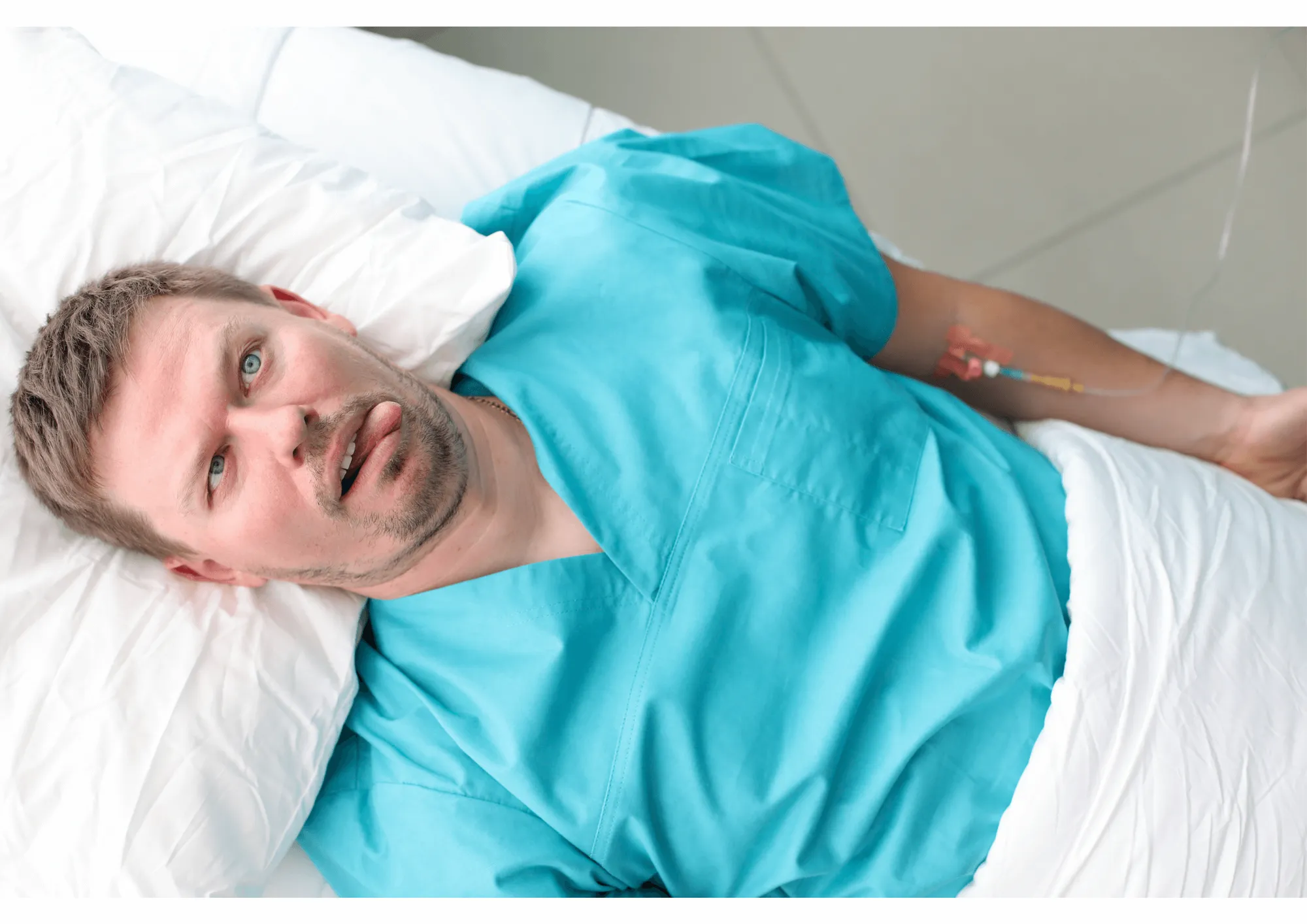
Finally I came across a sensible woman who simply took me to urology, where she was the head nurse, and put me in the free bed in a room with three other patients. To my delight they looked well, and I took heart that we were only the mild cases in here. All the more so because, after all the long walks between floors, my bladder had barely made a peep. After dinner, in visibly good spirits, each of us rang his wife and had the same conversation as the one before him. At last the head nurse coming on shift did her round. She told us that tomorrow we would be taken one by one to the theatre for our cystoscopy, and that if during the night we felt any need of her, FOR ANYTHING AT ALL, we should press the button to the left of our heads. If she had been younger and hadn't looked quite so stern, I would have joked that IF I CALLED HER FOR ANYTHING, it would be to give my bladder a little rub.
Before we fell asleep, I asked my “colleagues” whether they knew what the word cystoscopy meant, but being quite a bit younger than me, they were in the dark. Who knew what mythical monsters – Cystoscopies – would have them tossing and turning in terror that night. As the eldest, I thought it fitting to tell them about the origin of the word and about my hypothesis that this scopy of ours, the observation of our “kystis” – our bladders – would turn out to be harmless, and soon they fell asleep just like my two grandchildren did after I'd told them my very own fairy tale about Lisko and Ezhko.
In the morning the same nurse switched the lights on at 6 sharp, told us it was time for our personal hygiene and threw the windows open so wide that if any of us decided to jump, he'd have no trouble. She said breakfast would be brought at 7, and for the ward round at 8 we all had to be on our neatly made beds, not reading books, not talking on the phone, and wearing masks. By 8 we had long since told our wives what we'd had for breakfast, our beds were fit for a parade, and we had been holding our hands in front of us on the blankets for half an hour already. At 8:30 the whirlwind of the ward round swept past in less than half a minute, and a timeless void set in until around 11, when two nurses arrived. First they stripped one of us as naked as the day he was born, put him in a long white gown made of something synthetic, took him by both arms and led him off like an arrested member of the Ku Klux Klan (a racist organisation that persecuted Black people in the USA in the 1950s, known for its white hoods). The rest of us hoped they would bring him back to the room within 20 minutes at most. By 12:30 we were already wondering what on earth had happened to the poor chap, when a nurse came into the room and, with a face like a funeral, wheeled his bed out, and we heard the song of its wheels fading away to the left down the long corridor.
The colour drained from our faces. If this was how every cystoscopy ended, “better we had run”, as old Vazov once put it. In the middle of these thoughts about our “dear departed” cellmate, the same song came drifting in from the corridor. To our joy, the “colleague” was in the bed, but he was pale – as my grandmother used to say, “like someone who's been chased by snakes”. In his right hand he was clutching a clear plastic bag full of urine and blood, from which a tube full of the same liquid ran under his blanket. Clearly he had a catheter. The other two gave me the same look my daughter had given me when I'd taken her, as a little girl, to have a blood test after promising her that it would be not only painless but great fun. By around 5 pm we were all back in our room in the same state as the first one, our mouths silently cursing the whole universe like Hadzhi Dimitar in Botev's poem, and we refused dinner. Before going to sleep, I usually rewound the film of the day.
I remembered that in the “theatre” the nurses had asked me to take off the gown and lie down naked, lifting my legs onto something like a birthing trestle, and that I had stayed like that, listening to them, until the anaesthetic kicked in. At some point they woke me up. They gave me the catheter bag to hold carefully and, taking me by both arms, brought me back to the room, where the other three were moaning down the phone to their wives, but when dinner came they wolfed it down as if they'd never seen food before. I told them to eat mine too and dialled my wife's number. Before that, though, I peeked into my underpants and saw there that my penis, perhaps because it was sucking blood from the little tube to the reservoir, had become unusually large. I had only meant to reassure her that everything had gone well, but at the sight of this I couldn't resist boasting first: “If only you could see how big it is!”
To which she replied that I should insist they give me a smaller catheter. I told her it wasn't about the catheter, but about… and I fell delicately silent. She asked whether I had a temperature and what medication they were giving me. Then I repeated quietly, so the others wouldn't hear: “It's about my penis, not the catheter,” to which she replied: “If you're waiting for me to come over there and do that job for you, you've got another think coming! If it's that big, ask one of the nurses to change it for you, or you might get an infection!”
The next day the proportions in my underpants hadn't changed, but my urethra hurt like hell – a natural reaction to the growth, in my view – and I wisely told myself: “Grin and bear it, granny, beauty hurts.”
The others in the room seemed to be cross with me; they groaned excessively and complained to each other and to their wives, whom they rang every hour or so. I couldn't help thinking that none of them, unlike me, had done national service. I felt like yelling at them to stop being such wimps and to imagine, just for a second, that in that theatre, once they were up on the trestle, they'd had to give birth. In the middle of these silent thoughts, I remembered that I hadn't had a cigarette for 30 hours. Carrying my little container out of the hospital to smoke outside was out of the question. At my own risk, I puffed away one cigarette in the toilet, having first opened all the inner doors in there so there would be convection. I rang my wife and told her I had no problems whatsoever. I said it loudly, so the others would hear. They were already dividing up my portion in advance, since I had announced that I intended to fast for therapeutic purposes, and I got stuck into crosswords and puffing. I was glad that no visits were allowed during the pandemic. Otherwise their wives would have been at their sides all day long, would have found out what I was getting up to in the toilet and would have forbidden me to ruin their little hubbies' precious little lungs. The next day they discharged us. After they took out my catheter, the pain was already easing on the way home, but I could feel my new pride leaving along with it. Every wonder lasts three days.