
I remember how my grandfather, around lunchtime, would take out his pocket watch and shout:
“Anke, woman, it's quarter to 12!” Grandma would start scurrying about and lunch began at 12 sharp. My father also used to spur my mum on, though sometimes she only made it by 12.10.
Eating “by the clock” is typical of the army. There you march to the mess hall in formation, singing, you sit down and stand up on command, and no talking is allowed.
Missing a meal is considered a service to the enemy – he “would be delighted” if you didn't eat! What nonsense!
When I got married, I moved in with my in-laws as a live-in son-in-law. There people stuck to what you'd asked for:
“How many slices of bread do you want?” “Two!” (When I wanted at least three).
They gave me two.
“Shall I give you some more?”
“No, thank you, I've had enough.” (In fact, I wanted more, but I was too embarrassed to say so) and my mother-in-law didn't give me any more. At home Mum asked the same questions, but to my answer of “One slice”, she'd put down three and dish me up more.
When we were children on holiday with our parents, after breakfast we'd all dawdle about until it was time for lunch.
In front of the canteen there was a menu for the day pinned up.
From the crack of dawn till late at night people stood in front of it, discussing it fiercely.
Not because of the spelling mistakes: /Porc with rize, Meetball soop, Bean stoo, Chikken fricasay/ and so on.
The most frequent comment was:
“What, agaaain?” Even so, they stuffed us children there like broiler chickens. The grown-ups quietly pined for their favourite little dishes, but came back with a sense of duty fulfilled – “the kids have put on a bit of weight” – and told everyone what a wonderful holiday they'd had.
Once I went to see Mum and Dad at their country cottage. Mum was frying meatballs and said to me:
“Keep an eye on them, I'm going to wash your car!”
Soon my father came over to me:
“Where's your mother?”
“You know her, she's gone to wash my car.”
“And the little meatballs?”
“Here they are – I kept an eye on them, they're done!”
“Oh dear, you've ruined them!”
“What's wrong with them?”
Dad was so upset that he didn't even explain to me what the problem was.
Before a trip, my wife and I would leave our children with my parents and come back for them two days later. We, the enthusiastic mountaineers, would try to share our achievements – for example, that we'd been on “Koncheto”, a high mountain ridge in Pirin. It's considered difficult and not for everyone; it's even downright dangerous up there. While we were telling them, Mum would be rushing about to put something on the table and wasn't listening to us, and Dad would ask at the end:
“Where's that?”
We answer him:
“Above Bansko.”
“Oh, Bansko? I know it! Years ago our accountant from there married off his daughter and invited colleagues from all over the country. What a wedding – it'd blow your mind! Food and drink till you burst! Your mother and I barely made it home! Oh, I know Bansko all right!”
Another time we're telling them about our hiking exploits in Rila, at the BAK shelter, above the Malyovitsa hut. At the end Dad, managing to squeeze in between Mum's urging us to start eating, asked roughly where that was.
We answer him – from Govedartsi upwards.
“Oh yes, a colleague of ours, an accountant who was from there, once invited us for kurban soup and roast lamb. Yes, Govedartsi really is a wonderful place!”
Hospitality in Bulgaria, and, I suppose, among the other Balkan peoples too, is associated exclusively with food. To “show themselves” in a good light, hosts heap so much food on you that only a few guests manage to eat it all.
Years ago we were invited by some acquaintances of ours from “Gara Pirin”. They kept pouring generous amounts of homemade rakia into the little glasses and kept saying cheers. I watched my father-in-law, who, so as not to offend the hosts, would splash his glass under the table, so they wouldn't ask him why he hadn't drunk.
I was sitting next to him and my trouser leg was soon soaked through with rakia.
The people had made an effort with the dishes too. They'd killed a rooster; the soup was dark red and greasy. After it was served, my father-in-law smoked cigarette after cigarette. His soup went so cold that, from the fat in it, the rooster's comb in his bowl was now standing up straight.
The hostess kept urging him, and he kept saying “in a minute, in a minute”! After another 4 cigarettes she couldn't take it any more and asked him (my father-in-law, that is, not the rooster):
“Krum, why aren't you eating? You'll offend us like this!”
His wife blushed and made excuses for him:
“Well, he doesn't eat chicken!”
The hostess immediately whipped him up some fried eggs – huge, orange, swimming in oil. My father-in-law puffed away even harder. There was no way out, and in the end he himself confessed that he didn't like eggs either, but would gladly have some tea, white cheese and bread.
The hostess was delighted and brought him real homemade goat's cheese. My father-in-law drank the tea, into which he'd crumbled a hot chilli pepper, and smoked another four cigarettes.
My mother-in-law and I knew very well that he didn't eat goat's cheese.
To save the situation, I went over to the hostess and whispered to her:
“Please excuse my father-in-law! He adores cheese, but only if it isn't goat's. I think he's had a bit too much to drink, he's hardly going to eat anything here, but at home he'd happily nibble some sheep's cheese.” She jumped up, fetched a big lump of sheep's cheese from their cellar and wrapped it up for us to take home. She gave me a conspiratorial look and even winked at me.
I don't understand why people always talk about food in diminutives – little meatballs, a nice little stew, little stuffed cabbage rolls, a little salad and so on. For grandchildren, children and pets that works, but for food? If you say, “Pour me a drop of the old vino!”, you sound like a good, salt-of-the-earth sort. But “Pour me more wine!” – that sounds downright rude.
More and more often in today's films the following happens:
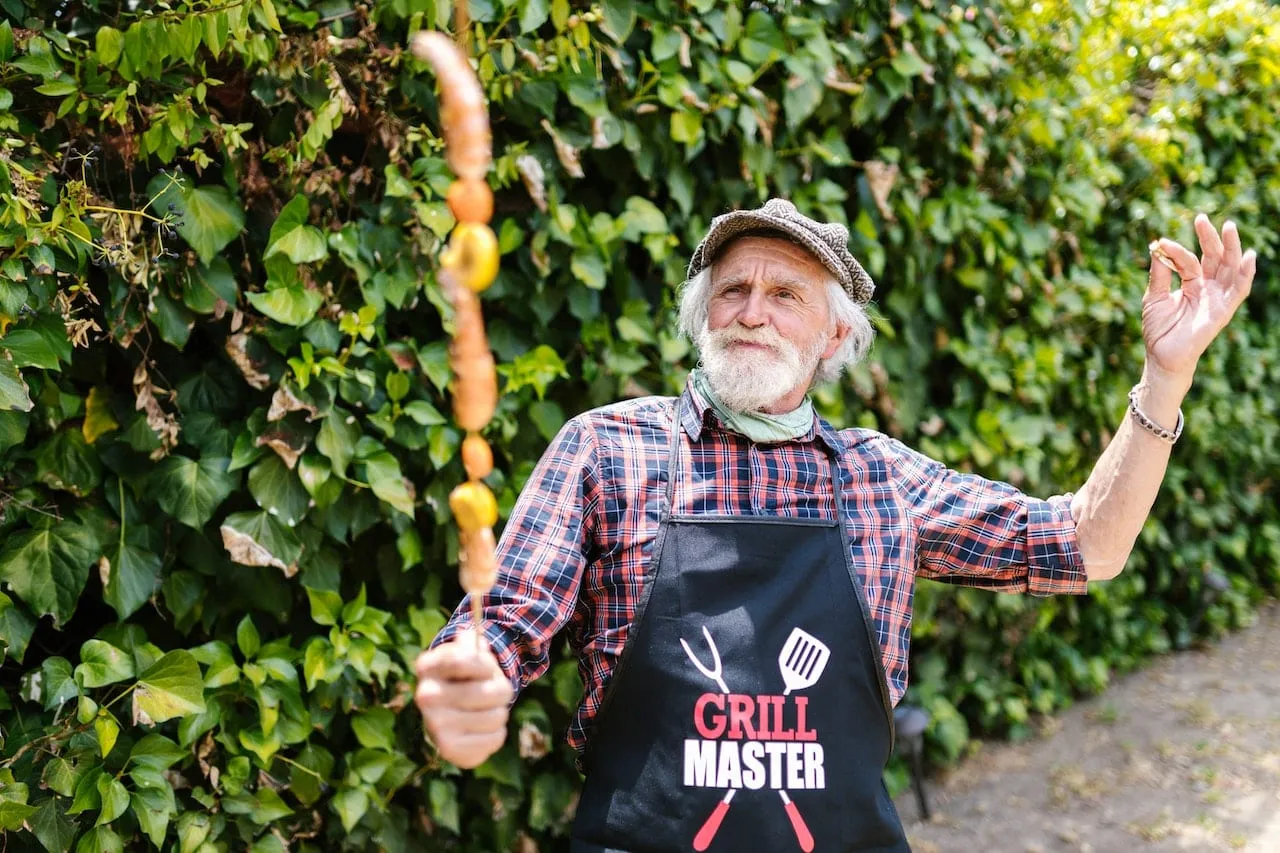
The hero and the heroine are getting closer. He invites her home – he's going to cook her a romantic dinner himself. She arrives, the host is in an apron. There are burning candles everywhere. In my opinion, he really ought to invite a firefighter as well, waiting discreetly behind the curtains. The food he's prepared turns out to be wonderful. Several times during the meal he points his fork at her with a little morsel speared on it, which she gobbles up as sexily as possible.
“The way to a man's heart is through his stomach,” married men love to say. After the wedding, though, they no longer put on aprons and don't cook for nothing.
I am a man and I state with full responsibility that a man's love runs somewhat lower down. And after a meal, sex is not up to scratch at all. The whole human organism then passively watches the stomach grinding away furiously and the intestines sucking out the nutrients. These two organs, the main ones at that moment, sprawl in the most boorish way right in the middle of us, like beys, aghas and chorbadzhii, and the rest wait for them to finish.
At the company I'm the boss of, I used to get very irritated when my employees stared tensely at the clock around lunchtime, even if a serious unresolved problem was still in front of us. At some point they'd jump up cheerfully:
“Well, would you look at that, it's 12 o'clock! Lunchtime!”
Everything is dropped, and for a whole hour all I hear is their comments on food, politics, TV, sauerkraut and goodness knows what. I tell myself, “It's only human, after all”, but I would definitely prefer them to eat after we've fixed the problem. Afterwards the same thing will take three times as long.
On business trips out in the provinces it's normal to have lunch wherever, whenever and however it comes. On one of them we walk into a restaurant. The waiter points us to a big table with his eyes. His forehead is covered in big beads of sweat and he's slurping tripe soup. My colleagues are hungry, but they quietly and understandingly comment:
“Ah yes, the man's having a bite to eat, we'll wait for him to finish!”
After five minutes I can't stand it any more and I say nervously to the slurper:
“Are you going to serve us? We're in a hurry.”
“Yes, yes, right away – just let me finish my soup and I'll be with you!”
My colleagues give me a look that means: “Why did you interrupt the poor man?”
The opposite of the case above is when you end up in an expensive place where there are far more waiters keeping watch than customers. They bend over you instantly, even if you just shift slightly. They'd even be ready to take you for a wee. They listen to you attentively. If you say, “and make it a little more well-done-ish”, they'll smother you with kisses. They present the dishes in such a way that you wonder why the national anthem isn't playing and where the guardsmen are.
Recently I read a curious travelogue about Africa. In one tribe, according to their customs, everyone ate alone, hidden somewhere in the bushes. In their view, eating was something very shameful, and they hid so that no one else would see them. Going by everything said so far, I must have lived there in my previous life. I'd be curious to see their reaction if I showed them a photo of some big restaurant. They would probably react the same way as the Bedouin whom Exupéry took to Niagara Falls. At the sight of the water sinfully pouring down, he fell to his knees and begged God to forgive us this insane waste.
At least in my opinion, God wanted to protect his creation – man – from an excessive elevation of his spirit, which would inevitably be followed by the extinction of the whole human race.
For that purpose he gave us various distracting pastimes – love, sex and death.
And above all – food, around which we revolve endlessly our whole lives long.