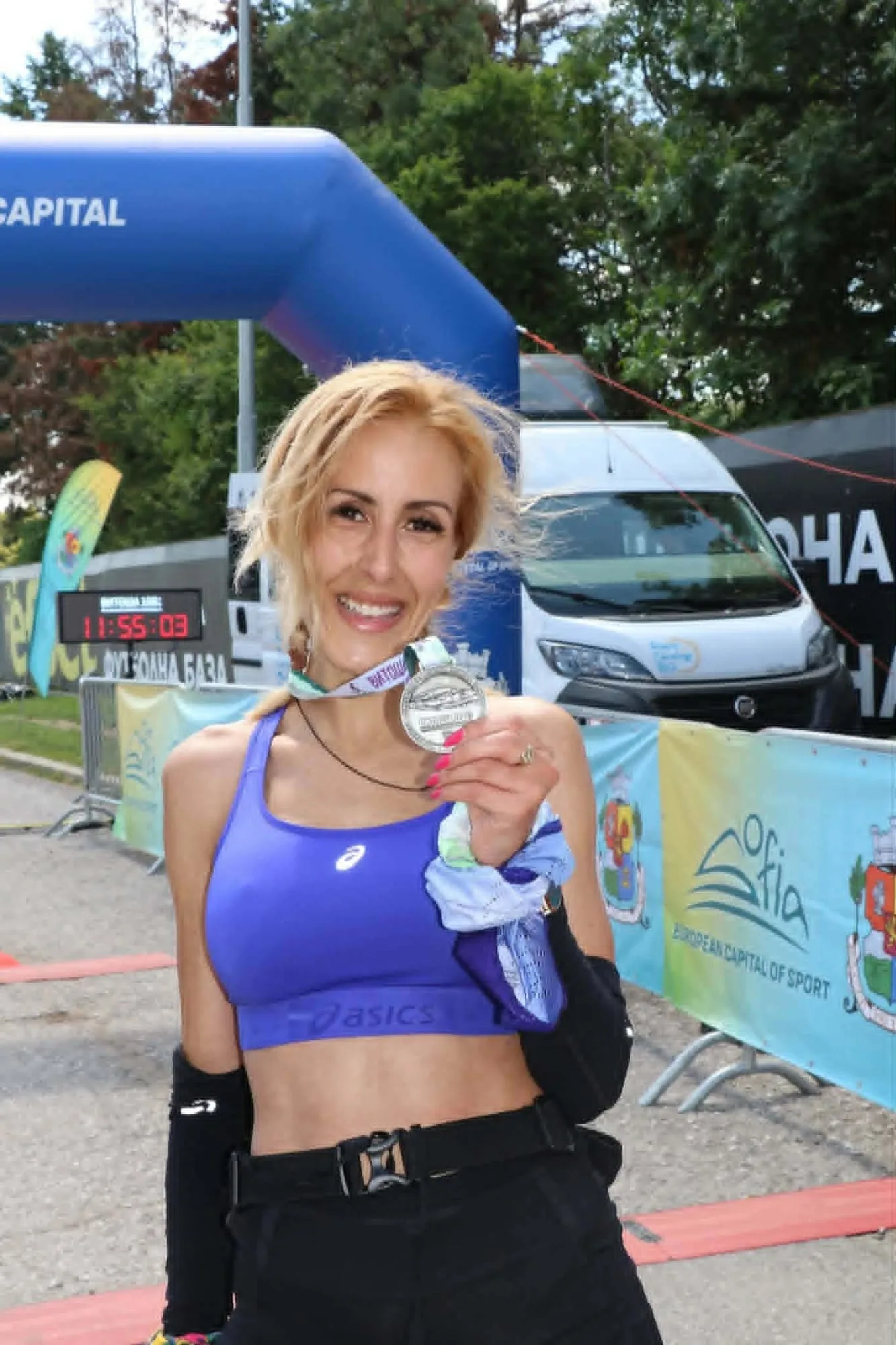

Not every race story has a happy ending. And some of them are so incredible they'd fit a film plot better than real life. Mine, it turns out, is one of those. And we're talking about just a marathon. In Cyprus.
A short backstory
After a good season of mountains, triathlons and a thousand other bits of madness, I gave more than three months of my life to preparing for a marathon. The block went well, my hopes were high and my legs were practically itching to punch through the tarmac. So far, so good.
On 15.12.2025 in Málaga I was supposed to have my moment of glory. Yeah, right. At kilometre 22 it was all over. Not because I wasn't prepared, but because I couldn't wake up for the entire race. At one point my heart rate and watts dropped and I just pushed my way to the finish.
Maybe two hours later I'd already paid the entry fee and bought plane tickets for my resit in Cyprus – with the clear idea that I just had to hold my fitness for a month.
Arriving in Cyprus
A month went by. I arrived in Cyprus – smiling, calm, after a few sauna sessions (for acclimatisation – the forecast said warm), no caffeine for 7 days, perfect nutrition, just as I'd been taught, and full of energy.
The adventures started the moment we landed. There was no early bus to Nicosia. We had to sit at the airport until midnight and wait. Then came the adventure with the taxi-limousine. All the traffic on the wrong side, me in horror because I had no idea where the cars were coming from. Sleep was next to nothing, but we still managed about six hours.
In the morning we went to “have a look around”. There was no arch. There weren't even any tapes along the course – just cars flying at you from every direction. And heat. So far, so good. The start was at 6:45 the next morning – in the dark. There were no more than 300 runners on the marathon distance. I said to myself: “Blimey, this course must be awful if nobody wants to do it.” I had no idea how awful.
Race day
Up at 4 a.m. Breakfast. Tea. Get dressed. Shoes on. Go. Warm-up. All according to plan. Leg check – so far, so good. I'd even slept well. I was grinning from ear to ear on the front line, despite the delayed start.
They had “forgotten” the plastic sheeting from the arch, plus a strange tarpaulin, wet and right on the start line in front of our feet. I pictured broken limbs and full orthopaedic wards. Thank God, they removed it.
We started.
Of course, I'd checked the course profile, but not the course itself. It turned out to be three streets that we repeated… many times. I think after the fifth time I just stopped counting. There was wind. There was rain too. It wasn't warm. And the traffic wasn't closed. We were breathing diesel with every metre.
Interestingly, the aid stations weren't exactly where they'd been listed either. But I kept smiling, running and taking in close to 90 grams of carbs per hour. And a bit of water – as a luxury.
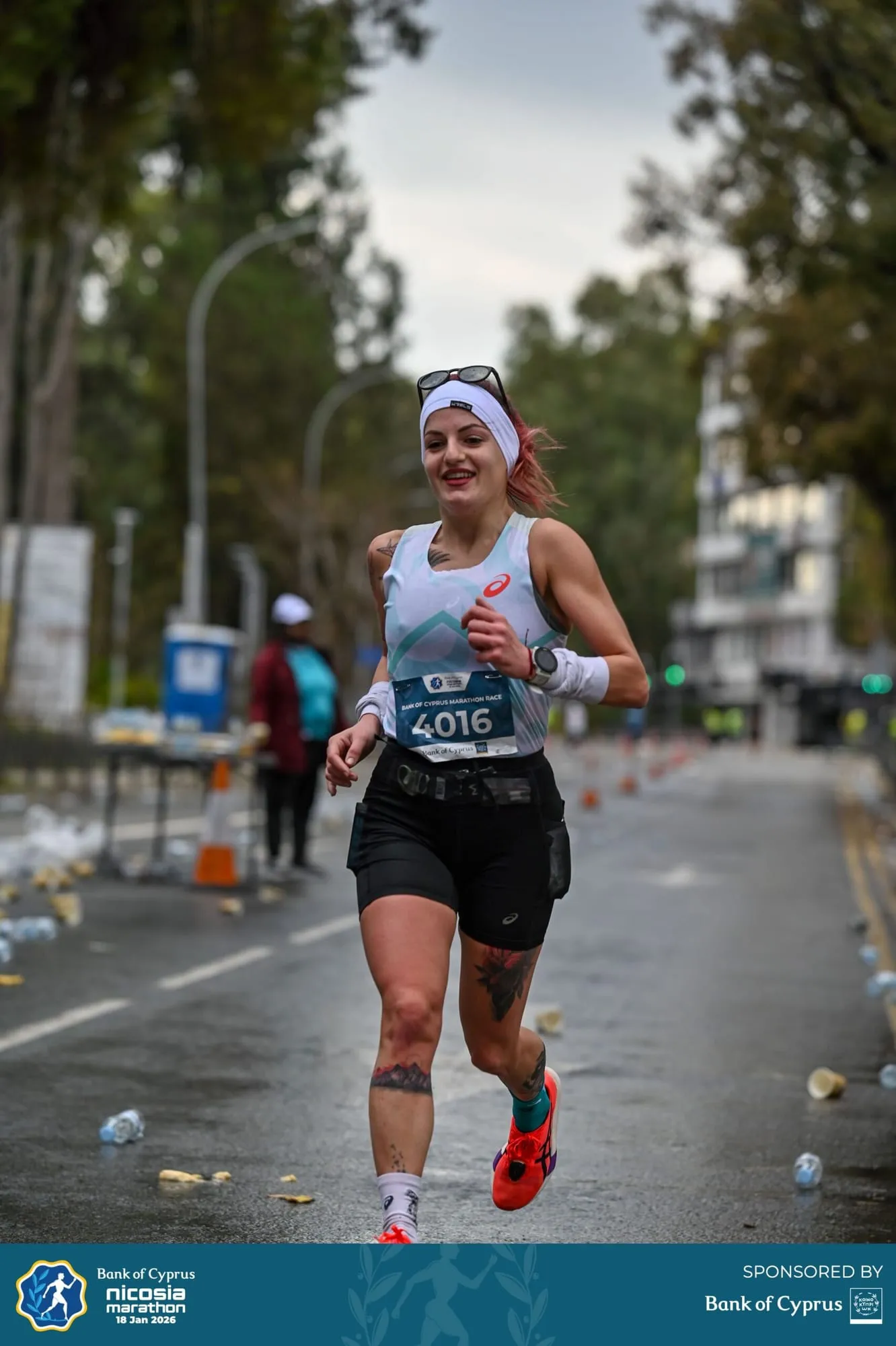
I was first until kilometre 10. Then an extremely impressive lady, visibly over 45, overtook me at full throttle. The whole time we moved together – no more than 300 m apart. At every turnaround (and there were lots) we even waved to each other.
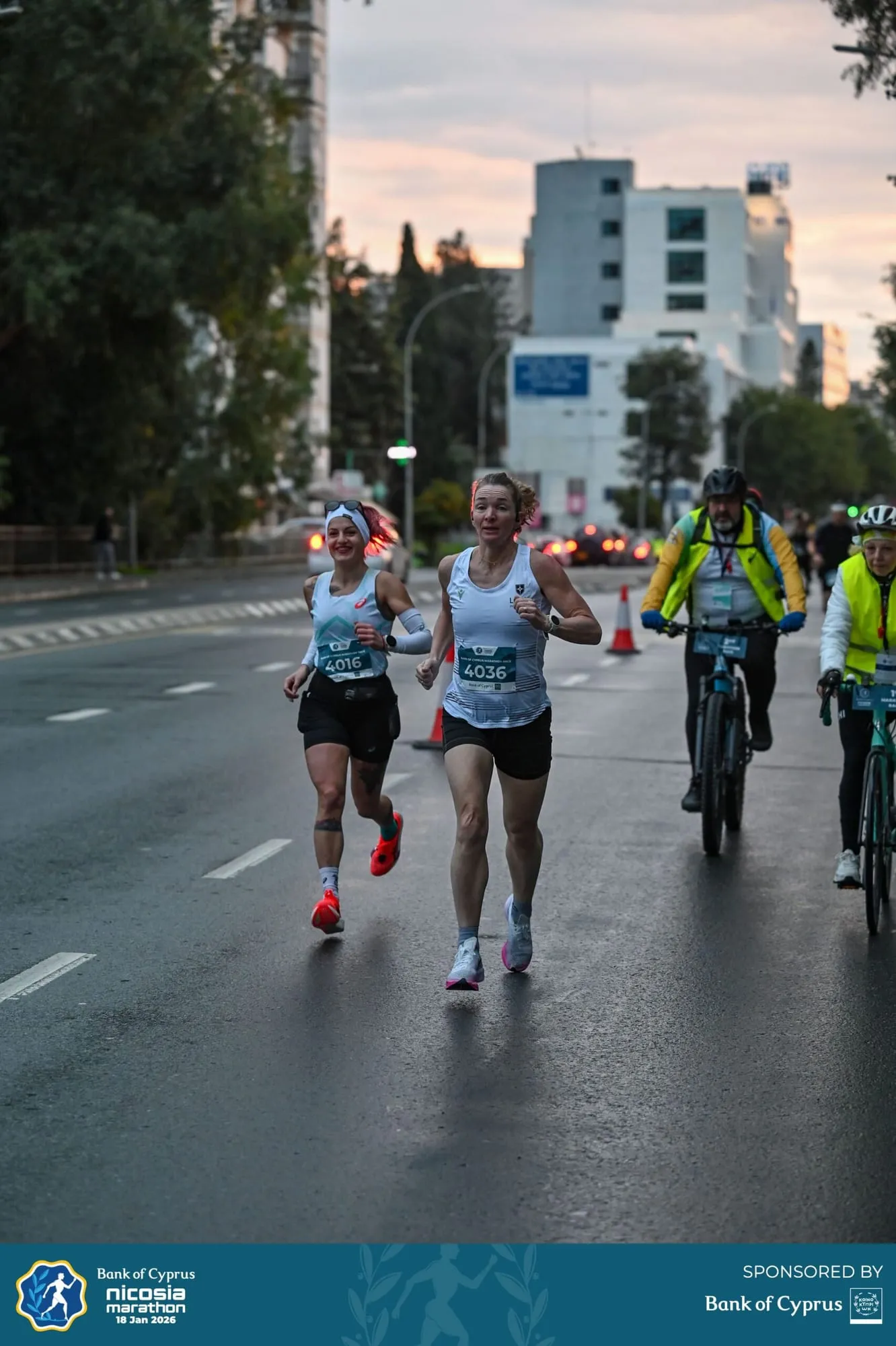
The wind picked up, the rain eased. At kilometre 29 my British companion started to drop back and I overtook her.
I think I was finally feeling the urge to push a little and get back to the plan of a sub-2:58:00 marathon. I was smiling, listening to my favourite music, and even the change of course after kilometre 30 did me good – we were now in the centre.
Mild cramps started at around kilometre 32, but nothing worrying. Another hill was coming – they'd sort themselves out. My watts were sitting at around 230, as planned. I wasn't looking at pace. I only noticed that my heart rate was lower than expected – around 165–168, even though I'd picked up the speed. I was drinking water and fuelling well.
The incident
The traffic, as I said, besides being on the wrong side, wasn't closed either. Cars were coming at me from what felt like the wrong side, and the cyclist escorting me, because I was in the lead, was riding right next to me on my left. But the road narrowed.
At kilometre 38 a car suddenly shot out on my right – from a car park. They tried to stop it, but the driver just carried on. And we, the runners, simply stopped to wait for him.
I looked at my watch – 2:46:40. I had under 1800 m left, and downhill at that.
I heard a car again and jerked my head to the left to check what was happening with the cyclist. Pure instinct. Far too sharp a movement. I looked straight ahead again, but then everything in front of me tilted 90 degrees. The road had tipped to the right. I staggered and fell. My vision blurred for a few seconds.
There were people around me – volunteers. Nobody came. A fellow runner helped me. I got up, saw that my knee was bleeding (a trademark ASICS FrontRunner move), told myself everything was fine, and carried on. Now at about 4:00 pace – there was a gentle downhill coming.
I knew my coach Slavi would meet me somewhere. He appeared and tried to run with me. Later he told me I'd been too fast for him.
200 m to the finish. I was elated – happy, smiling. Despite the fall I was going to get a time of around 2:56:00, which was perfectly satisfying.
The finish that wasn't a finish
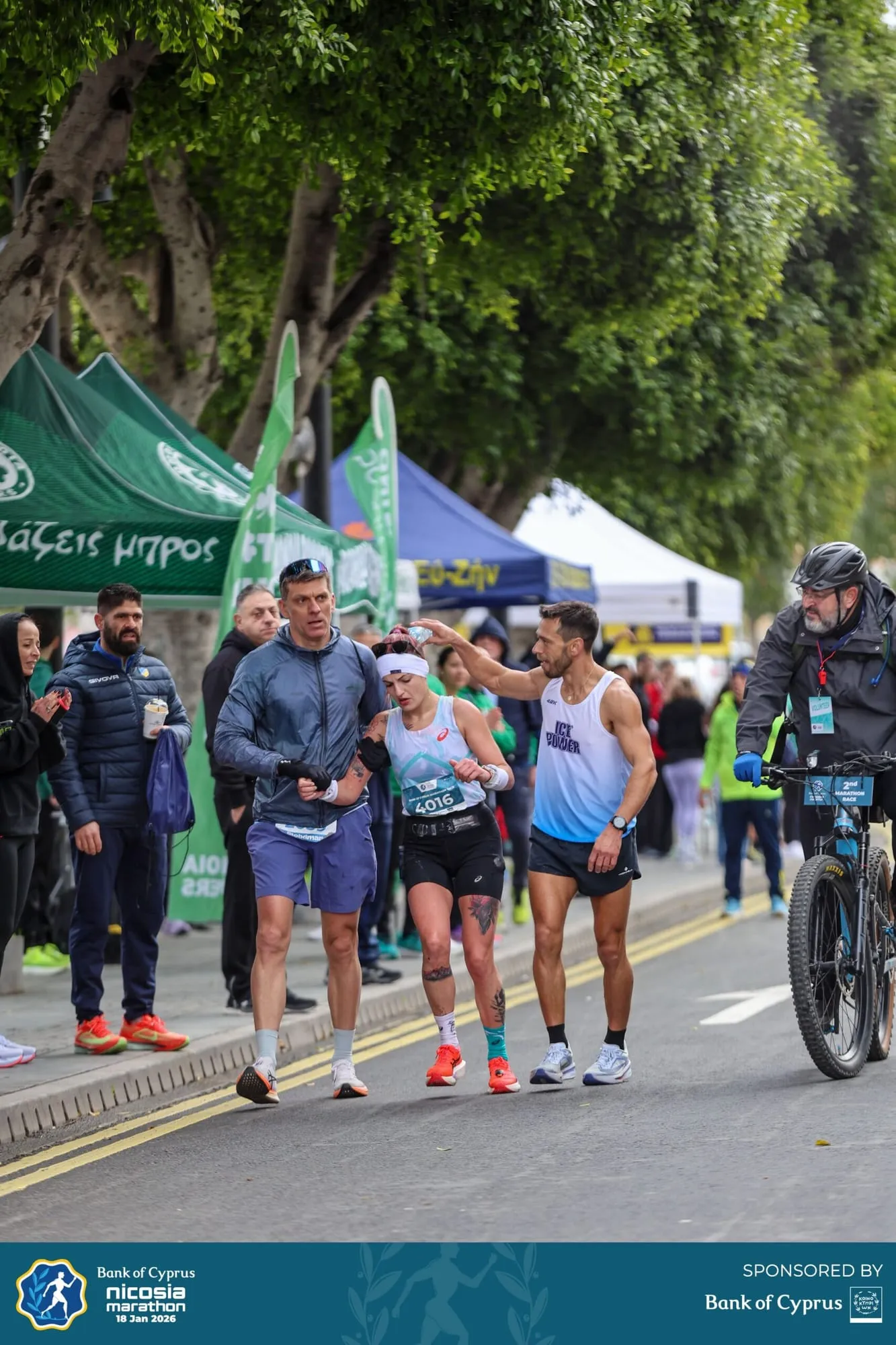
And then everything started spinning again. Tilting. Wild nausea and vomiting set in. The whole right half of my body locked up. My vision blurred. At one point all I could see was one big red blotch in front of me.
Slavi grabbed me so I wouldn't fall again. I tried to walk – or rather, they were trying to make me stop running on one leg and blind, but I kept pulling away. In the end I gave in and walked.
The second woman overtook me exactly 20 m from the finish.
A wheelchair was waiting for me, and I simply sat down in it. Everything around me was fog and blotches. Objects seemed to be circling around me – up, down. They took my blood and measured my blood pressure – all normal.
I explained in English that I was dizzy, that I couldn't see and that I had a sharp pain in my neck. Nobody paid any attention. I didn't understand what they were saying to each other either. And I couldn't see clearly what was going on. They made me lie down, and things got so bad that I had to ask Slavi to sit me up. I sat up again. Drank some water. Stood up. Went to the event organiser.
They said they wouldn't give me an award because I'd been led by the hand to the finish. They even said I'd been pushed. I was stunned. I asked why there had been no medical team anywhere except at kilometre 8 of the course. I also asked why the “medical staff” on site hadn't checked my eyesight. Lots of questions – and zero answers.
Afterwards
I walked back to the flat. Another mild episode followed – for a few seconds. I couldn't wait to get back to Bulgaria and find out what had happened.
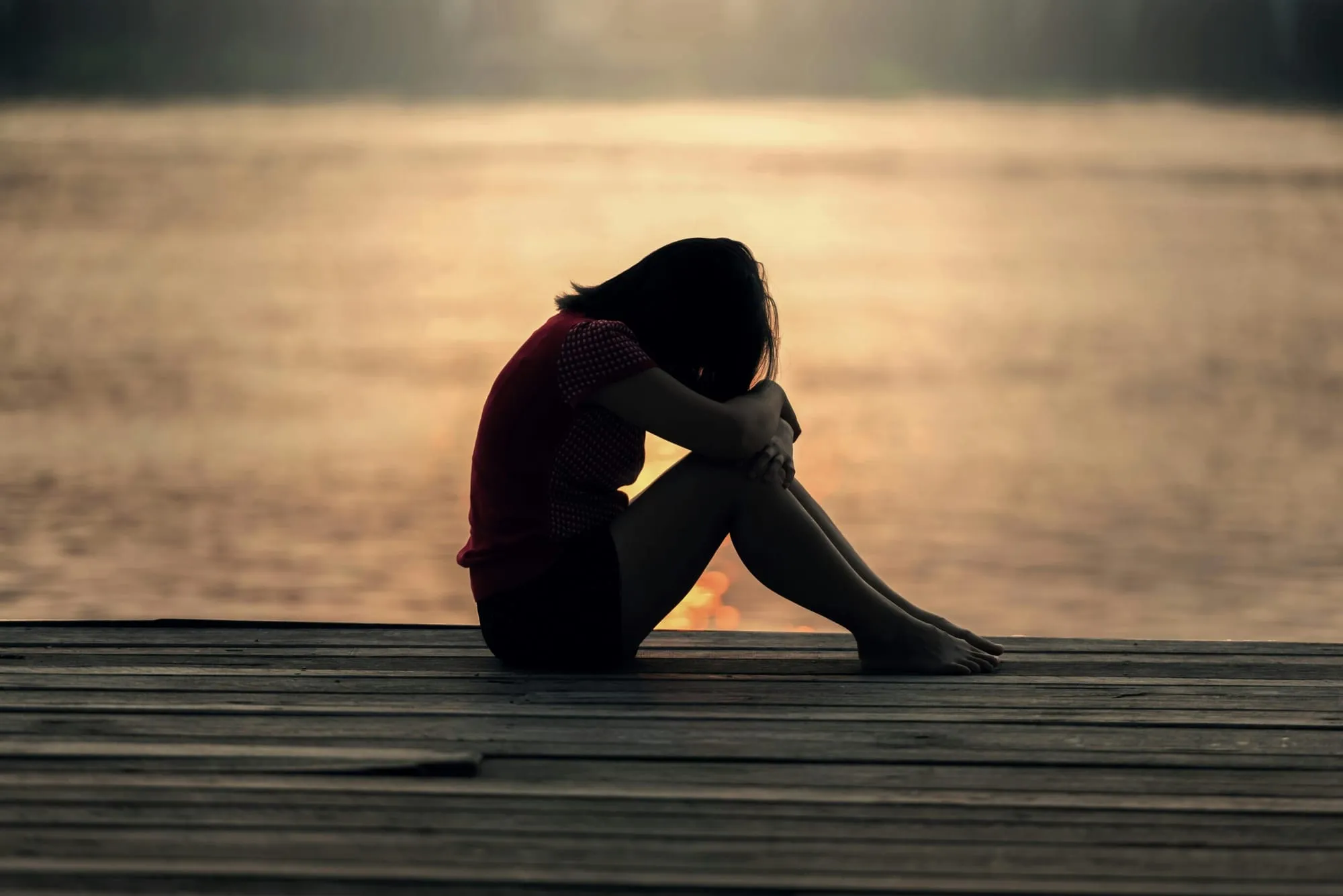
The flight was delayed. I slept on a bench at the airport. Then on the plane. Then in the car too. I couldn't drive – I'd been forbidden to. People came and took my car home. I joked and laughed about the whole thing, cracking lame jokes about how if it was an aneurysm, at least they'd be rid of me quickly. All of it nicely masked my horror. And my outright fear. Fear that they might forbid me from doing the things I love. Not fear for my life. Not that.
The diagnosis
First thing on Monday – to a neurologist. First diagnosis: a narrowed vertebral artery – 1.6 mm against 4 mm on the other side. They sent me for blood tests, did a Doppler and ordered an MRI. A bit grudgingly – it wasn't really necessary, they said, but because of the neck pain.
I went in calm again, thinking at least they'd see whether I had some kind of hernia making my neck hurt for two weeks. They handed me the result and pulled me aside. The doctor looked at me seriously and said:
“Girl, things are not good at all. You've had a stroke.”
Shock.
How on earth do you have a stroke at 33? From what? Stress? Problems? Something else? I was silent, in a stupor, and didn't know what to say. As the child of doctors, I knew perfectly well what all this meant. I also knew what a high price I had paid, once again, for everything I'd had to go through over the last two years.
This great examination called magnetic resonance imaging passed through the hands of at least seven specialists. I got seven different opinions. In the end I made it to a neurologist in Frankfurt who dared to make a diagnosis. Finally. Or rather three of them.
Now there's a new MRI ahead because of a suspected vertebral artery dissection, cardiology tests and vascular diagnostics – to find out what's what.
The new plan
No, sport isn't forbidden. But I'm staying deep in zone 2 until the cause is pinned down. I've changed my plans. I've taken it as a sign from fate that maybe it's time to give up the speed torture on tarmac. And to give up the mental stress.
I keep training – 10 days after the event, still with a smile and with pleasure. With slight leanings towards extremism – steep descents, rocky ridges, a craving for adrenaline. Reborn and ready, with fresh strength, to live this second life the way it should be lived.
And yes – they told me it's a miracle I survived. And that I have no after-effects. I smile at that too.
The finish
I'm a fighter. I'm not someone who gives up just like that. I'm a true warrior – with enviable willpower, even in the middle of a stroke. And I'm more ready than ever to chase my goals, only this time I'll learn to draw that thin red line in time. For everything. Above all, for people.
Catharsis.
Both emotional and physical.
See you in the mountains. Soon. 🏔️