
This story describes real people and events from the period 1975–1978.
A fellow student of mine had told me that a friend of his who was studying medicine had mentioned that, at the end of their lectures, one of their professors had more than once called on his students to become sperm donors, because the Medical Academy was short of them. My friend was surprised that the future doctors weren't responding, even though they had recently even started paying 5 leva “per session”.
- “And what does a session mean?”
- “They give you a little bottle to deliver the ‘material’ into.”
- “And you fill it at home over a few days?”
- “No. I've already looked into it. They ring you, and the next day at the agreed time you go there, ‘load’ the bottle and collect the money. Two sessions a week at most. I've already made up my mind, and you – suit yourself!”
I was rather embarrassed; it seemed like a sordid sort of trade to me and I didn't answer him straight away. That same evening it dawned on me that my parents had spent a fortune on my brother's wedding. They were paying off a crushing loan, so ten leva a week would come in very handy. For the record, that's equivalent to about 150 of today's Bulgarian leva. Every year I gave blood, so why not become a sperm donor too, which is for money? A few days later the two of us went to the Medical Academy to “apply”.
They took blood, urine and microbiology tests, we were examined by a neurologist, an andrologist, an internist, a psychologist and a surgeon. They asked us about hereditary conditions and finally took our home telephone numbers. I was worried that I wasn't tall and might be rejected because of it. The next day they called us in.
We had been approved so far; all that remained was to check our sperm counts. They gave us a little bottle each and pointed us to a room, which we went into one at a time. There were pictures of naked women in there, which in those days was something unheard of. We were pretty expeditious. Some of our “material” spilled on the floor and the only delay was cleaning it up. I'll probably never understand why clinics in Bulgaria give patients such tiny little bottles, even when they're taking stool samples.
We waited outside. Later they called us into a room, but not the one with the pictures. We sat down opposite a doctor and two middle-aged nurses. The doctor began a briefing. Our sperm counts were “fruitful”, i.e. there were a lot of spermatozoa per unit of fluid and the percentage of motile ones was quite high. What we heard didn't flatter us but alarmed us. With our girlfriends, both of us used the “withdrawal” method, where you can sometimes be a bit late. In those days condoms seemed to be made of galosh rubber and were even dusted with talc. Using them was like smelling a rose through a gas mask.
The doctor went on. The women came here shortly before ovulation. They were given successive “infusions” from one and the same donor, whose material had just been collected. The donor was obliged to have abstained from sexual intercourse for at least three days, so as not to reduce the “fertilising power” of his material. For us this meant we were allowed only one day a week for our girlfriends. Finally he had made a long pause, in which he fixed us through his glasses, and had said:
- “And now I'll leave you to the nurses, ‘who will be collecting your material’” – and he went out.
I admit that this expression had reminded me of a fellow soldier who, before the army, had worked as an inseminator. They kept the bull in a pen, and as soon as they put a wooden model of a cow in front of it, he was obliged to get into the pit under the bull, like at a garage, to “help” it at the right moment, collect the precious fluid in a plastic bag and pour it with a special device into some cow from the list.
The nurses dispelled our doubts. They stressed that a woman, after three “infusions”, simply glowed with hope that she had conceived, and it was important that outside the Academy we didn't waste our material. They would look for us on our home telephones, and once we'd fixed a time, we were to be punctual for our meeting the next day on the fourth floor, where we were to start strolling about casually. On passing one of them, if she gave us a sign, we were to keep walking. If she didn't give one, she would hand us an empty little bottle with a stopper and the key to room No. 8 on the third floor, which we were to “load”, return to her together with the key, and collect our five leva.
These “manoeuvres” were necessary because of the women's very keen interest in the donor. They would follow the nurses around in the hope of at least catching a glimpse of him, and under the law that was not permitted. They gave us forms to fill in with our personal details. We also signed declarations to the effect that while we were donors we would abstain from sexual contact.
We soon saw the value of the briefing. There were times when a nurse was walking towards us, but if she sensed a “tail” behind her, she would make a gesture meaning: “Not now!”. Some of those “passings” we repeated 5–6 times, going down and up floors, following her movements out of the corner of our eye. When she was sure she wasn't being followed, she would give us the bottle and the key and chat with us a bit. Both nurses took a very lively interest in what we were studying and how we were getting on with our exams. They were very nice and we quickly became friends.
Little by little they started calling us in three times a week, despite the rule of at least three days between sessions, but they gave us the freedom to choose a time that suited us, even if it meant them staying on after hours for our sake.
The room on the third floor where we had to deliver the material, my mate and I called the “Handicrafts Room”. Unlike the ones in schools, it was about 2x2 metres, with one chair, and when you sat on it your hands touched the shelving units stacked with dusty files reaching right up to the ceiling. Unlike the room where they had done our sperm counts, there were no erotic pictures. We weren't fussy, and we had made a commitment, and usually we managed. Still, it had happened to both of us now and then:
You go in, switch on the light, lock the door and sit down. You switch off the light to summon up an erotic thought, but it flies away like a rare white swallow. You give yourself a break and switch the light on again, but the powerful 100-watt bulb overhead starts frying you. Just then it had been discovered that hens in poultry farms laid more if the lights were kept on round the clock. You switch it off, but then realise you don't know where you've put the little bottle. You switch on, find it, put it within reach and switch off again, but the numbers from the Toto 2 lottery come into your head, the silly argument with your girlfriend, and the fact that you're doing very badly in one of your subjects. Your watch starts ticking. Panic grips you that the client's ovulation may already have passed and the nurse is getting fed up waiting for you. Because of you, the clumsy one, people are suffering. In the end you practically force yourself and “lay your egg”. On the way back you clutch the precious little bottle, determined to hold on to it even if a bomb drops.
After long delays, my “colleague” and I finally plucked up the courage to ask the nurses to provide suitable visual aids in “our room”, as far as they could. I'm sure we both had in mind a particular picture from the room where they'd done our sperm counts. The next day in our room there was a yellowed newspaper cutting:
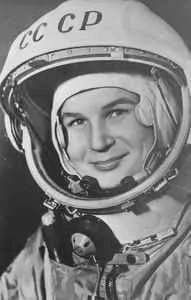
Valentina Tereshkova. Archive photo
For the information of the current generation, I'll explain that Valentina Tereshkova was the first woman cosmonaut. The photo didn't help us, even though the woman in it was “wearing nothing but a spacesuit”. We had the feeling she was even mocking us:
- “You're wanking? And I'm flying in space!”
We soon turned her picture to face the wall. Another year went by. We had long since confessed to our girlfriends that we were doing this, but only once in a blue moon and with noble motives, although that wasn't exactly true.
At least once a month the nurses would give us each an envelope with a box of chocolates and a bottle of cognac. And on “Grandmother's Day” – 8 January – the day of midwifery – whisky, and they didn't ask us for any material. After a while we got curious about whether “there were results”:
- “There are – we didn't buy the chocolates and the cognac, the women who got pregnant did!”
That had pleased us, but also worried us a little. Soon we both married our girlfriends and asked the nurses to sign us off, but they pleaded with us:
“Look, my dears, we've never had donors like you before. Before, they were any old riff-raff, and the women hope the future father will be young, handsome and clever. Ever since you've been with us, we answer their questions quite honestly that you're top students. Quite a few of them only decide on this kind of conception then!”
They kept ringing us and asking for just one more little bottle, then one last one, and so on. As well as the five leva, they now gave us a little cake or a slice of gateau too, probably their own handiwork. This shared ordeal dragged on for several more months.
To this day, on “Grandmother's Day”, by tradition I drink a glass of cognac, even though I don't like the stuff. It started to bother me that I had unwittingly meddled in other people's destinies. Somewhere out there are children of mine, and I know nothing about them or their mothers. And it would be even worse if I found out. A few years ago I finally all but shouted at myself:
Don't think you're getting wiser! Maybe you were cleverer as a young man, even in being a donor! What's done is done! You, your wife and your two children live happily. Don't dig up the past – it's better to part with it with a laugh and with forgiveness for yourself and for time itself.
That's exactly when I wrote this story.