
Part of the text below is in the main character's own lingo.
In 1992 four of us engineers set up a private company, which got off to a very good start at first. We rented three rooms in the centre of Sofia – in a building with an inner courtyard and parking spaces. “As an inheritance” we also got a cleaning lady who had worked there for the last 30 years – Auntie Radka.
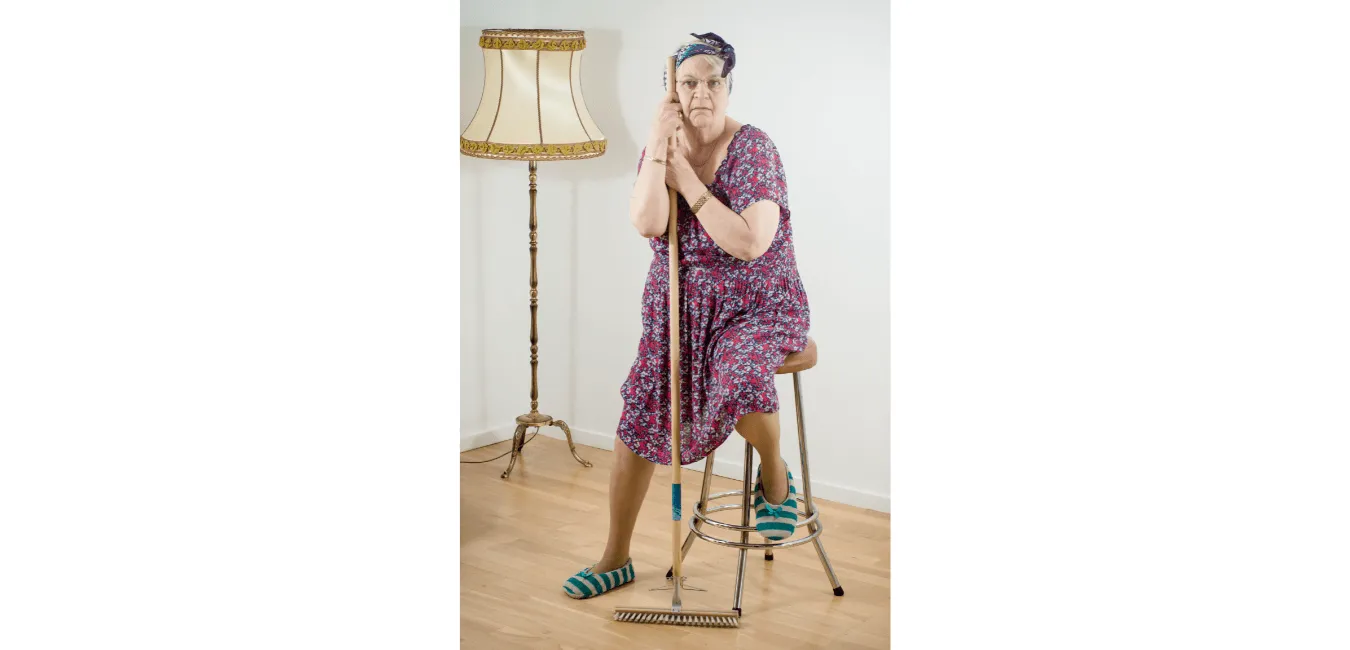
She was over 80 – tiny, with a snub nose and grey mousy eyes. We soon realised she was an optimist and an ultra-resilient specimen of the human race. In the hyperinflation that came along years later, she told us cheerfully that with all them jars she had up in the attic in Pozharevo and in Lyulin, nothin' scared her. Her son and daughter-in-law were sickly, but she weren't gonna leave neither them nor the three grandkiddies hungry. We wondered how she managed.
Her working hours with us were from 17:00 to 18:00. She'd come in with the feeling that we'd been waiting for her impatiently and look for someone to have a natter with. She loved to plant herself in front of them and start telling them, chin propped on the handle of the wet mop, how she'd cured a neighbour of corns – soaked her feet in caustic soda; how she'd sorted out an epileptic – when he had a fit she hammered 4 nails in around him; how she'd healed her son, who was filling up with water – she kept his feet in a basin of children's wee and rubbed his belly with garlic and lard; how she protected her tomatoes from blight, and so on – all mysteries worthy of “National Geographic”, “Survivor” and “Guinness”.
When her audience /my employees/ left, she'd say to me, the boss:
“Right, now I'll get crackin', Bogo.” First she'd wash the coffee cups. The next morning we'd “break” them off their saucers and joke that she'd washed them with Loctite. Then she'd start “moppin'” in my room. So as not to get in my way, she wanted me not to get up from my chair:
“Sit yerself down, Bogo, jus' spread yer legs!” She'd slop the rag over my shoes too. Her creed on cleanliness was simple – wet is clean, and dry is dirty. Once a month she'd decide to wash the windows too – only mine. Again she insisted I didn't get up – “jus' a tick”. She'd climb up via a little stool onto my desk and start wipin'. The dust fell on the desk and on me. In front of my screen were her legs, and under her wet galoshes – my drawings, some of which I barely managed to save in the 45 seconds before she sprang nimbly down onto the floor without the help of the stool:
“Ooh, look how it's sparklin' in 'ere, Bogo! Go on, tell me it ain't true! Some young 'un'd be scratchin' at that there pane a whole hour, but I ain't a dawdler like them lot.” She'd launch into her standard topic – her neighbour in Pozharevo – and I'd hurry to hide in the toilet. Even through the door she wouldn't stop asking me what we thought about the matter. She'd wait for me to come out and follow me about until I admitted that the woman hadn't been right at all. Next came the topic of the other cleaners in the building. Today so-and-so was supposed to mop the stairs, but she'd made out she was done in. And so it all come down to her:
“Now you tell me, is that right? It ain't!” I raised her salary several times, but when it reached 1/4 of my other employees' pay, I stopped – despite the questions in her mousy little eyes and her upturned snub nose.
I think she was troubled that it was only with me that the conversations never went anywhere. She looked for new plots from Pozharevo and “Lyulin”. She started enlightening me about my colleagues' sins against the company, against me, or against their wives. Because of my silence, there followed:
- “Me, Bogo, whatever's on me 'eart, I says it straight out – I can't go carryin' it about unsaid.” She reminded me of a poem by Valeri Petrov in which he described how his neighbours were cross that his dog barked too much. He put it in the car and left it somewhere far away. A week later it came back beaten, dirty, thin, and said: “Let me in. I promise – from tomorrow I'll bark twice as loud!”
If sometimes she had no one to chinwag with, she didn't lose heart. She'd talk to the rag on her own, something like: “Now Granny's gonna wring you out an' give you a nice drop o' water!” And to the floor she'd say: “Now Granny's gonna wash you an' you'll shine like a bathed grandkiddie!” Hearing her from the corridor, I too started saying to my work, like her: “Now big bro's gonna sort you out an' be off 'ome.” It rarely worked for me.
One evening, as I was savouring the solitude in which I had an idea how to improve the machine we were making, the phone rang. During the day we'd rush to answer it in the hope it was a customer, so as to be the first to announce the good news. Usually it was the wife of one of the staff and he'd start repeating: “Yes, yes, all right.” The rest of us would lower our eyes in disappointment.
This time, though, the call was from one of our distributors. An Italian customer of theirs for our machine wanted them to come round in an hour. I promised to wait for them and started daydreaming – maybe they'd buy more than just one machine and we'd each get a few leva for Christmas. I got crackin'. Back last winter we'd switched off the central heating to save money. In the little rooms we froze, each with one feeble fan heater. I gathered them all up and switched them on in the office. I took off my thick clothes, cut my nails with wire cutters and cleaned them with a screwdriver. Auntie Radka was just leaving. I called her back and asked her to take out the rubbish, wash the rooms once more, and the stairs too. I gave her an extra tenner. She mulled it over, mulled it over, then asked:
- “Jus' tell me why yer in such an 'urry and when I gotta be done!”
- “Auntie Radka, I'm expecting important guests in half an hour. I want this place to gleam!”
She came with a full bucket. She held the handle of the mop and, with movements like competitive rowing, generously flooded everything. She didn't wring out the rag – she just rowed with it and slapped it on the floors. She ran off to refill the bucket almost in silence. Finally she sat down in the office, right in the deepest spot. Her look suggested she wanted me to share with her who these ever-so-important guests might be. Although there was still time, I worried they might walk in right now and see me hobnobbing “with the secretary”, her short little legs crossed, in thick granny tights. I had to get rid of her fast. I fixed my eyes on the computer. No matter how surprised I looked at the screen, she kept nattering on. I thanked her and said she could go. She replied somewhat evasively: “It ain't never been so warm in the office.” I started arranging the table with machines and leaflets. I kept going in and out to break up her story and make her give up. Finally she said:
- “Seems the guesties'll be late, an' I ain't waitin' for 'em no more!”
I barely held back from kissing her all over.
The water on the floors was drying, and the sneaky dirt was floating up. I felt like grabbin' the bucket an' the rag meself, but I lit a cigarette instead. From the courtyard came a racket. That was nothing unusual, but I went straight down there. The dog, Johnny, usually just growled at strangers, but today he was baring his teeth menacingly and barking ferociously at two women, our distributor and a man. The porter was powerless, but out of nowhere Auntie Radka appeared and started whacking the dog with the broom handle. He knew he'd never get the better of her and started whimpering. She tied up his chain and shoved him into his kennel. One of the lady guests handed her 20 leva with the words: “Grazie, signora!”
In the office I made coffee. Their interpreter introduced me to the Brizzi family. They drank the coffee grimacing, but started speaking in my beloved Italian, and I pretended not to understand. It became clear to me that “for the same thing”, God alone knows what, they'd been asked for 60 000 euros in Italy. Finally they settled on 10 000 – “dieci mila”, but whether euros or leva – and whether for us – I didn't catch. They nodded to the interpreter, and she, in my opinion, improvised:
“The Brizzi family is prepared to invest in your machine – not as a finished product, but as something for you to develop further towards detecting the hidden denomination in the security thread of the future euro banknotes. They would pay 5 000 leva, but only for a proven final result – when you send them a working machine with this function. For this purpose they are giving you, free of charge, this magnetic head, the fruit of the efforts of many engineers in Italy, for you to build into your machine.” She translated this for them too. Hearing “cinque mila leva”, they barely hid their smiles.
We exchanged phone numbers and agreed to keep them informed periodically about how far we'd got. According to them, a really solid business of mutual interest was taking shape. Years earlier I'd have asked them for more money, but our company was heading towards its end, and 5 000 leva would come in handy – unfortunately, only after Christmas. The distributor objected, but I didn't haggle at all.
The next day Auntie Radka practically flew into my room and asked what on earth had happened last night with the guesties. She heard me out and pronounced her weighty verdict:
“Them lot looked like bad folk to me, Bogo! Don't go gettin' mixed up with 'em for nowt.”
Every day after that she didn't look for new topics, but stubbornly repeated that we shouldn't go working for the spaghetti lot for nothing. I had doubts too, but from a technical point of view the task was very interesting. One day, with my head buzzing, I snapped at her to stop talking to me about them. She practically bared her teeth:
- “All right, Bogo, I'll shut me trap. Jus' lemme tell you, them lot 'ad shifty eyes.
The 20 leva that bitch gave me, I ain't even gonna touch 'em! I've nailed 'em to the wall at 'ome with four nails, so they don't put a curse on me family. I'm cross I stopped the dog Johnny when they come. 'E'd sniffed out what sort o' folk they was too. Simple old Granny Radka's tellin' ya – even if ya see money from 'em, better not touch it.”
Even if she was right, if we stopped, we'd last another two months – without hope; and if we carried on for nothing – we'd still sink, but more beautifully. I chose the second.
After a very hard month we sent the machine to Italy. Silence followed. We doubted ourselves more and more. I was also beset by suspicions that they were probably copying it right then, but I was calm – there was no way they could copy my firmware. Two months later they paid the 5 000 leva advance, but asked for three more machines, which they'd pay for once they'd sold them over there. We strained every sinew and sent them with the company's last money. In the new endless silence, filled with vain hopes, we ran through the partner-owners' personal money too, and finally let the workers go, and Auntie Radka as well. If there was anyone whose future we weren't worried about, it was her. She'd probably outlive the lot of us.
Actually, it wasn't the Italians who sank us. The four of us managed fine as engineers, but not as managers. Auntie Radka was a cleaner, but her true calling was PR, Common Sense, Survivor. It'll sound funny, but I think our company might still be alive if she'd been our General Manager. She'd have kept a tight rein on me, the other partners, the workers, the Italians and the new cleaner. Who knows – somewhere in Italy?
I wrote this story in the hope that I too might get it all off me chest like 'er, an' mop out with the old rag some thoughts that are still scurryin' about for nowt in me 'ead, so's I might feel a bit lighter.